
When You Fear Regret: Making Decisions Without Perfect Certainty
When You Fear Regret: At some point in life, many of us may have stood in front of a decision and wished that someone could simply tell us which choice will never hurt us later. It may be about a relationship, a job, a course, money, family, health, moving to another city, saying yes, saying no, staying, leaving, speaking, or remaining silent. We look at one option and immediately imagine what could go wrong. Then we look at the other option and imagine losing what the first one could have given us.
The decision may be happening today, but the mind is already travelling into tomorrow and asking, “What if I regret this?” Sometimes we postpone the choice, ask the same people again, search for more information, compare the options repeatedly, or wait for a feeling of complete certainty that never arrives. When You Fear Regret, the real struggle may not be only about choosing between two options. It may be about wanting a guarantee that whichever path you choose will protect you from disappointment, loss, guilt, or self-blame.
This is deeply human. Regret is painful because it asks us to imagine that another version of our life might have gone better. The mind naturally compares “what happened” with “what might have happened.” That ability can help us learn, but it can also make a decision feel much heavier than it actually is. The aim is not to become careless or to stop thinking before choices. The aim is to think enough to make a reasonable decision, and then allow life to move forward without demanding impossible certainty.
Why Fear of Regret Can Make Decisions Feel So Heavy

Regret is usually connected with comparison. After a choice, we may compare the actual outcome with an imagined better outcome: “If only I had taken that job,” “If only I had spoken earlier,” or “If only I had waited.” Before a choice, the same process can happen in advance. We mentally simulate possible futures and try to avoid the one in which we see ourselves saying, “I made the wrong decision.” Researchers describe this as anticipated regret. A review of decision avoidance in the U.S. National Library of Medicine / PubMed notes that anticipated regret, emotional discomfort, uncertainty about preferences, and difficulty comparing options can all contribute to avoiding or postponing decisions.
The problem is that imagined futures are not evidence. They are predictions created from our memories, fears, hopes, and current emotional state. We may be very skilled at imagining the pain of a wrong choice while being much less skilled at imagining our ability to adapt, learn, repair, or change direction later. When You Fear Regret, the mind can therefore overestimate the importance of choosing perfectly and underestimate your capacity to cope with an imperfect outcome.
When You Fear Regret: The Difference Between Careful Thinking and Getting Stuck
Careful thinking has a purpose. You identify the decision, collect relevant information, understand the realistic options, consider consequences, check your values, and then decide. Getting stuck looks different. The same information is reviewed again and again without producing meaningful new understanding. You may keep asking for reassurance even after people have answered you, repeatedly search online, imagine increasingly distant “what if” situations, or reopen a decision after it has already been made.
A useful question is: “Am I learning something new, or am I trying to remove the feeling of uncertainty?” If you are still gathering information that could genuinely change the decision, thinking is useful. If nothing new is being added and the mind is only asking for one more guarantee, the process may have shifted from problem-solving into reassurance-seeking or rumination. This is where a reasonable decision can become emotionally exhausting.
When You Fear Regret: Why Perfect Certainty Is Usually Not Available
Many important decisions are made with incomplete information. We cannot know exactly how a relationship will develop, whether a new workplace will suit us, whether a business opportunity will succeed, or how we will feel about a decision five years later. The American Psychological Association notes that uncertainty can be stressful and recommends focusing on what is within our control rather than trying to control everything that is not. This is important because When You Fear Regret, the mind may treat uncertainty itself as a sign that you should not decide yet.
But uncertainty does not always mean danger, and it does not automatically mean that more thinking will create a better answer. Sometimes the most realistic position is: “I do not know exactly how this will turn out, but I know enough to take the next reasonable step.” That is not careless decision-making. It is accepting the limits of prediction while still using judgement.
When You Fear Regret: The Hidden Wish Behind “What If I Regret It?”

Under the fear of regret there is often another emotional wish. We may want to protect ourselves from being blamed, from feeling foolish, from disappointing someone, from losing an opportunity, or from having to admit that a decision did not work. People who are highly self-critical may find regret especially threatening because a disappointing outcome quickly becomes a judgement about the self: “I should have known better,” “How could I make such a mistake?” or “This proves I cannot trust myself.”
In these moments, the decision is carrying more than its practical consequences. It is carrying your self-worth. When You Fear Regret, it can help to separate the two: a decision can turn out differently from what you hoped without proving that you are foolish, weak, or incapable. Good judgement does not mean predicting every future outcome. It means making the best choice you can with the information, values, responsibilities, and circumstances available at that time.
A Neuropsychological Perspective: Why the Brain Compares Possible Outcomes
From a neuropsychological perspective, regret is not produced by one simple “regret centre.” Decision-making involves systems that evaluate possible rewards, losses, emotions, memories, and expected outcomes. Research reviewed in Regret and the Rationality of Choices describes an important role for the orbitofrontal cortex in integrating emotional and cognitive information related to regret and in comparing what happened with what could have happened.
This helps explain why choices can feel emotionally powerful even before anything has gone wrong: the brain is capable of mentally representing alternative outcomes and learning from them. That ability is useful, but under anxiety it can become overactive in everyday life, with the mind repeatedly comparing imagined futures rather than committing to the present decision. The practical goal is not to stop the brain from evaluating consequences; it is to prevent endless comparison from replacing action.
When You Fear Regret: Regret Is Not Always the Enemy
Regret can sometimes be useful. It may tell us that a choice was inconsistent with our values, that we ignored important information, or that we need to behave differently next time. Healthy regret can lead to apology, repair, learning, better boundaries, or a new decision. The problem is not the emotion. The problem begins when fear of ever feeling regret becomes so strong that we stop participating in life.
No meaningful life can be completely free from choices that later look different. We change. Other people change. Information changes. Circumstances change. A decision that was sensible at twenty-five may look different at forty because the person looking back now knows things that the earlier self could not know. When You Fear Regret, judge the decision not only by the eventual outcome but also by the quality of the process you used when you made it.
When You Fear Regret: Do Not Ask a Decision to Do More Than It Can
Sometimes we secretly ask a decision to guarantee our happiness. “If I choose the right career, I will never feel uncertain again.” “If I marry the right person, the relationship will never become difficult.” “If I wait for the perfect time, I will not fail.” Decisions cannot carry that responsibility. Even good choices require adjustment, effort, communication, patience, and sometimes repair.
A more useful question is not “Which option guarantees that I will never regret anything?” but “Which option is most consistent with what I know, what matters to me, and what I can realistically manage now?” That question returns the decision from fantasy to life.
When You Fear Regret: A Simple Way to Make a Difficult Decision
1. Define the real decision
Write the decision in one clear sentence. Many people feel overwhelmed because they are trying to decide five things at once. “Should I leave my job?” may actually include income, identity, family expectations, health, location, and future career. Clarify what must be decided now and what can be decided later.
2. Separate facts from predictions
Make two columns: “What I know” and “What I am predicting.” Facts might include salary, distance, working hours, medical advice, or an actual conversation. Predictions might include “Everyone will think I failed,” “I will definitely be unhappy,” or “This opportunity will never come again.” Predictions deserve consideration, but they should not be treated as established facts.
3. Identify your values and responsibilities
Ask what matters most in this decision: health, respect, family, learning, financial stability, independence, safety, honesty, or something else. Values do not always tell you exactly what to do, but they help you understand what kind of decision you want to be able to stand behind.
4. Decide how much information is enough
Set a reasonable boundary for research. For a small reversible decision, a few minutes may be enough. For a major decision, you may need days, professional advice, or several conversations. But even major decisions eventually need a stopping point. When You Fear Regret, more information can become a way of delaying the emotional discomfort of choosing rather than improving the quality of the choice.
5. Look at reversibility
Not every decision is permanent. Some choices can be tested, reviewed, or modified. A short course can be tried. A work arrangement may have a review period. A routine can be adjusted. Recognising reversibility reduces the pressure to treat every choice as a life sentence.
6. Use the “good-enough” decision rule
A good-enough decision is not a careless decision. It is a choice that is reasonable, informed, consistent with your values, and proportionate to the importance of the situation. Once you have reached that point, allow yourself to choose even if some discomfort remains.
After the Decision: Do Not Put Yourself on Trial
After choosing, the mind may immediately begin checking: “Was that definitely right?” This can lead to repeatedly comparing the option you chose with the option you left behind. Remember that the alternative future exists only in imagination. You may imagine its benefits while forgetting the difficulties it might also have contained.
If a decision does not work as expected, review it with fairness. Ask: What did I know at the time? What did I reasonably believe? What changed afterward? What can I learn now? What can I repair or adjust? This is very different from saying, “I should have predicted everything.” When You Fear Regret, self-trust grows not from proving that every choice was perfect but from learning that you can respond constructively when life does not go according to plan.
When You Fear Regret: When Worry Keeps Reopening the Decision
If the mind repeatedly returns to a decision, give the worry a structure rather than allowing it to occupy the whole day. The NHS Every Mind Matters guidance suggests writing worries down, setting aside a short “worry time,” separating solvable problems from hypothetical worries, and returning attention to the present when worry takes over. In decision-making, this can mean writing down the unresolved point, deciding whether any useful action exists, and postponing further review until the agreed time rather than checking the decision mentally every few minutes.
This approach also connects with our earlier Live Again India articles When You Need Certainty and When Thoughts Keep Returning. The mind often becomes stuck not because it lacks intelligence, but because it keeps asking thought to provide a level of certainty that life cannot provide.
When You Fear Regret: When Fear of Regret Needs More Attention
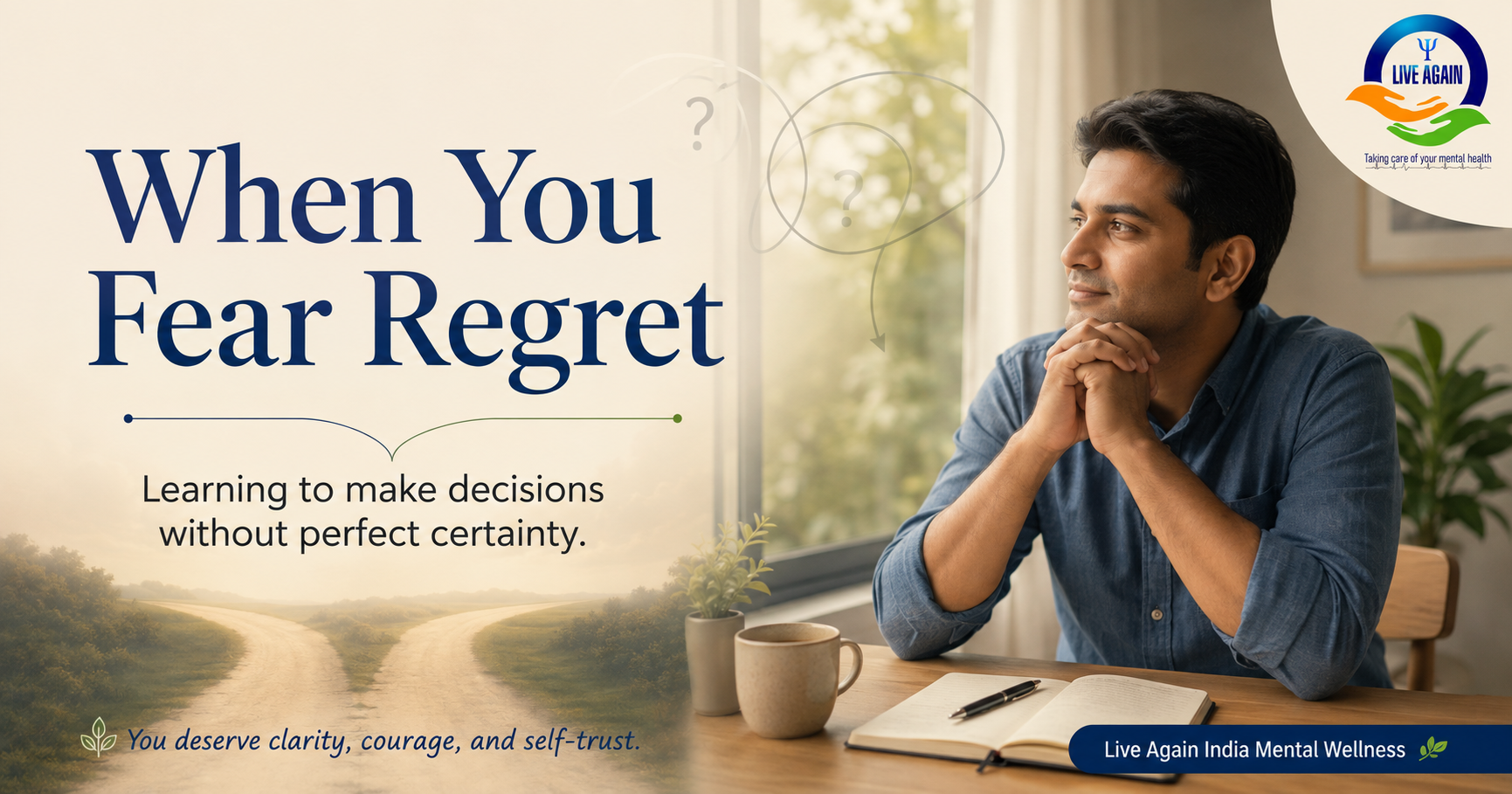
Fear of regret deserves professional attention when decisions consume hours of the day, ordinary choices become exhausting, you repeatedly need reassurance, you avoid important opportunities mainly because you fear choosing wrongly, or the decision-making process is strongly connected with anxiety, obsessive checking, depressed mood, trauma, or severe self-blame. In those situations, the aim is not simply to become “more decisive.” It is to understand what emotional threat the decision represents and work on that underlying process.
You should also seek timely professional support if decision-related distress is accompanied by hopelessness, thoughts of self-harm, suicidal thinking, severe sleep disruption, major functional deterioration, or inability to manage daily responsibilities. These require broader clinical assessment rather than only a decision-making technique.
The Decision You Can Make Today
There may never be a moment in which every doubt disappears and one option glows with complete certainty. Sometimes courage is quieter than that. It is collecting what you need to know, listening to your values, accepting what you cannot know, choosing the next reasonable direction, and allowing yourself to learn as you go. When You Fear Regret, remember that your future is not created by one perfectly protected choice. It is also created by how you adapt, repair, learn, ask for help, and continue after the choice has been made.
Today’s Reflection from the Therapy Room
A mature decision is not a promise that nothing difficult will happen. It is a choice made with the best understanding available today, together with trust that you can respond to tomorrow when it arrives.
How a Therapist Can Help You
A therapist can help you identify whether fear of regret is being driven by anxiety, perfectionism, excessive responsibility, obsessive doubt, low self-trust, past experiences, or another emotional pattern.
Therapy can help you separate facts from predictions, reduce repeated reassurance and overchecking, and practise making proportionate decisions while tolerating some uncertainty.
Where appropriate, approaches such as cognitive behavioural therapy, exposure-based work, mindfulness, and values-focused interventions can be adapted to the individual rather than used as one fixed formula.
Welcome to Live Again
Welcome to Live Again. Live Again India Mental Wellness is supporting you – you are not alone.
If fear of making the wrong choice has kept you stuck, exhausted, or repeatedly doubting yourself, your experience deserves understanding rather than judgement.
You do not need to know every future consequence before you are allowed to take a thoughtful step in the present.
With support, reflection, and practice, you can build a relationship with yourself in which decisions are guided by clarity and values rather than by fear alone.