Late Night Screen Use: How Social Media Keeps the Brain Awake
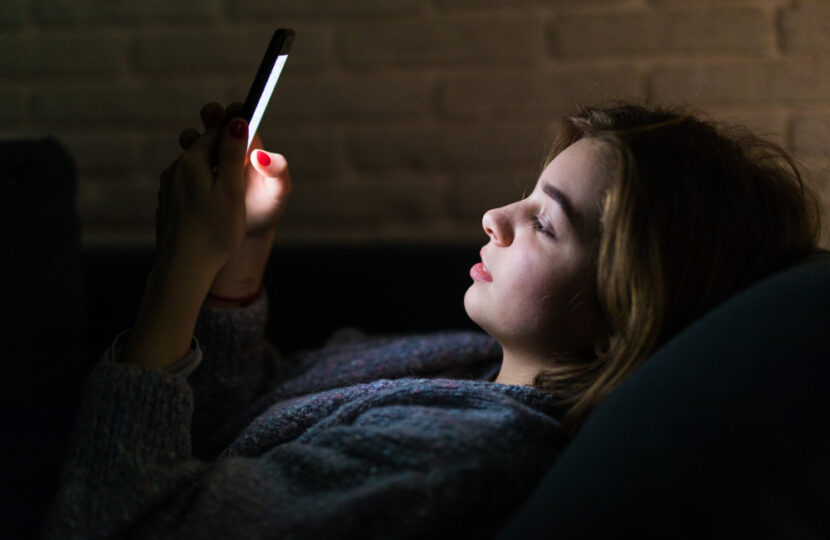
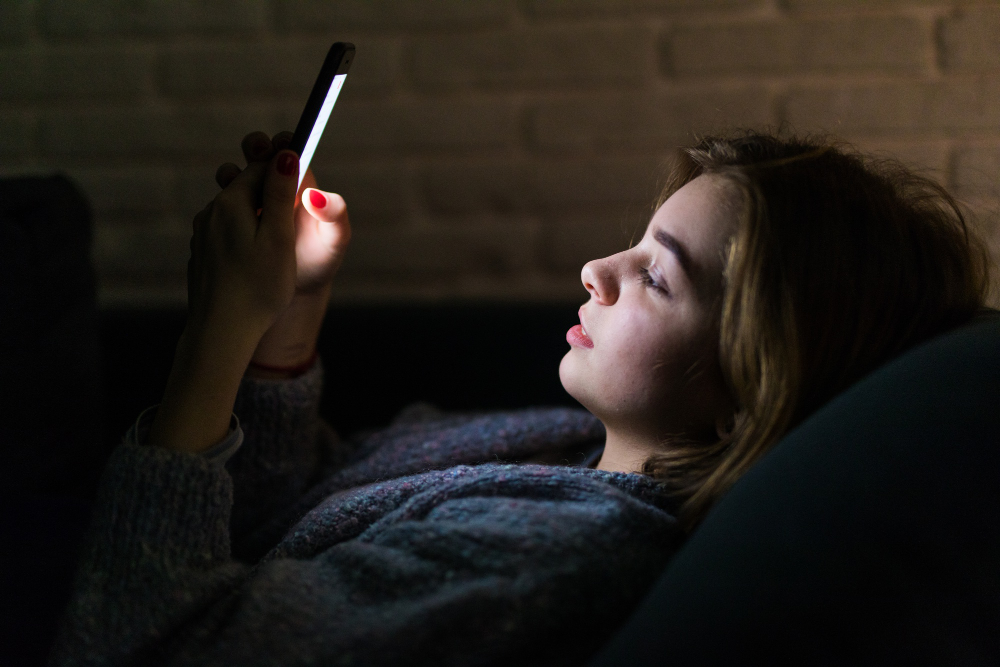
There are evenings when the body is clearly tired and we genuinely intend to sleep. We lie down, pick up the phone “for five minutes,” and begin scrolling. One short video becomes another. A face appears, then a message, a joke, a relationship reel, a news clip, an attractive image, an argument, a comment, and another face. Forty minutes later, the body is still tired, but the mind feels strangely awake. Late Night Screen Use helps us understand why this happens. Let’s understand how Late Night Screen Use and Social Media Keeps the Brain Awake.
The answer is not simply that the phone emits blue light. A smartphone at bedtime can do several things at once. It delivers light to the eyes. It delays the point at which we stop engaging with the world. It presents rapidly changing information and repeatedly captures attention. It can also provoke emotion, comparison, anticipation, attraction, worry or social curiosity. Sleep can therefore become a competition between biological sleep pressure and several wake-promoting inputs.
Our recent Live Again India articles on Melatonin and Circadian Rhythm and Circadian Clock and Sleep explained two foundations of sleep: recognising biological night and building sufficient sleep pressure. Today we add a third layer. What happens when the environment keeps stimulating the brain just when it needs to disengage?
Late Night Screen Use Is More Than Blue Light
Public discussion often reduces screen-related sleep problems to one sentence: “Blue light is bad for sleep.” The reality is more nuanced. The 2024 National Sleep Foundation consensus statement reviewed screen use across the lifespan. It examined screen content, pre-sleep light and behavioural strategies. The strongest consensus concerned children and adolescents. The panel did not conclude that every screen effect is equally established in every age group.
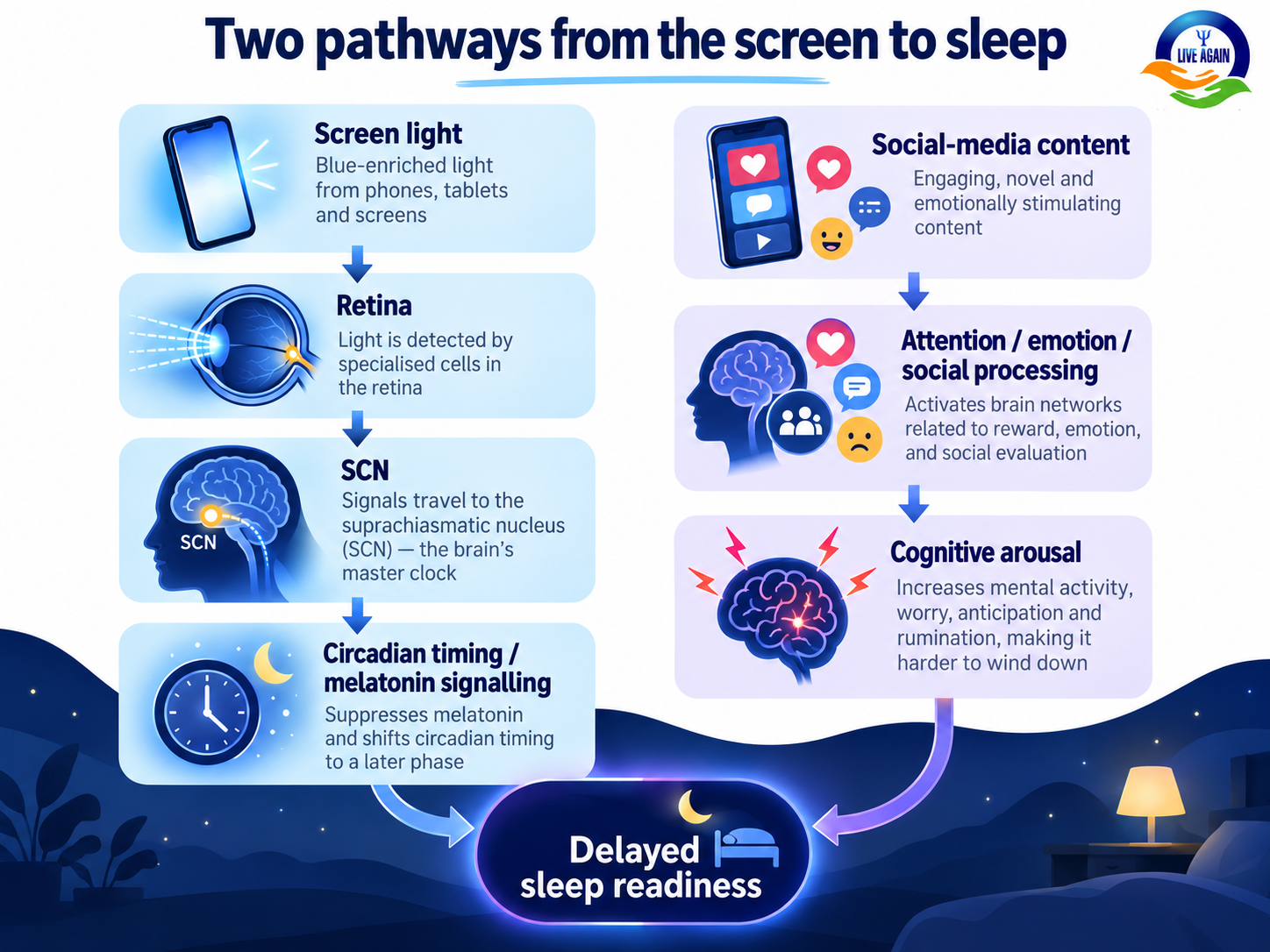
A useful way to understand Late Night Screen Use is through four overlapping pathways: light exposure, sleep displacement, cognitive-emotional arousal and nighttime interruption. One person may mainly lose sleep because scrolling delays bedtime. Another may become emotionally activated by what they watch. Someone else may be more sensitive to bright evening light. Many people experience more than one pathway at the same time.
This distinction matters. Turning on “night mode” may reduce part of the light exposure, but it does not automatically solve a problem maintained by stimulating content, endless scrolling, unfinished conversations or repeated notifications.
Late Night Screen Use: How Screen Light Reaches the Circadian System
The circadian system uses light as one of its most important timing signals. The National Institute of General Medical Sciences explains that the suprachiasmatic nucleus, or SCN, functions as the brain’s master clock. Retinal light information reaches this clock, and downstream signalling helps regulate pineal melatonin according to the light-dark environment. In ordinary conditions, evening darkness supports the biological transition toward night.
A bright screen close to the face can provide an alerting light signal when the surrounding environment would otherwise be darker. Short-wavelength light is particularly effective at stimulating melanopsin-containing retinal pathways. However, wavelength is not the whole story. Brightness, distance, duration, timing and individual sensitivity also matter.
The scientifically responsible message is not that every screen “destroys melatonin.” Evening light can influence circadian timing, especially when exposure is bright, prolonged or close to habitual sleep time. Reducing unnecessary bright light late at night can therefore support a clearer transition toward biological night.
The Screen Is Also Delivering Information
A phone is not a lamp. It is an information machine. While we are lying physically still, the brain may be processing speech, movement, music, captions, facial expressions, humour, conflict, attraction, threat, social status and personal messages. The room may be quiet, yet the nervous system is still engaged.
This is where Late Night Screen Use becomes psychologically important. Sleep onset requires more than physical tiredness. It also requires some disengagement from active monitoring, problem-solving, social evaluation and emotional response. When meaningful information arrives every few seconds, that disengagement may be repeatedly postponed.
Our earlier Live Again India article Sleep and Cognitive Arousal discussed how worry, planning and mental effort can keep a tired person awake. Social media can provide an external version of the same problem. Instead of the mind generating every new thought, the feed supplies the next stimulus for us.
Why Faces and Eyes Capture Attention
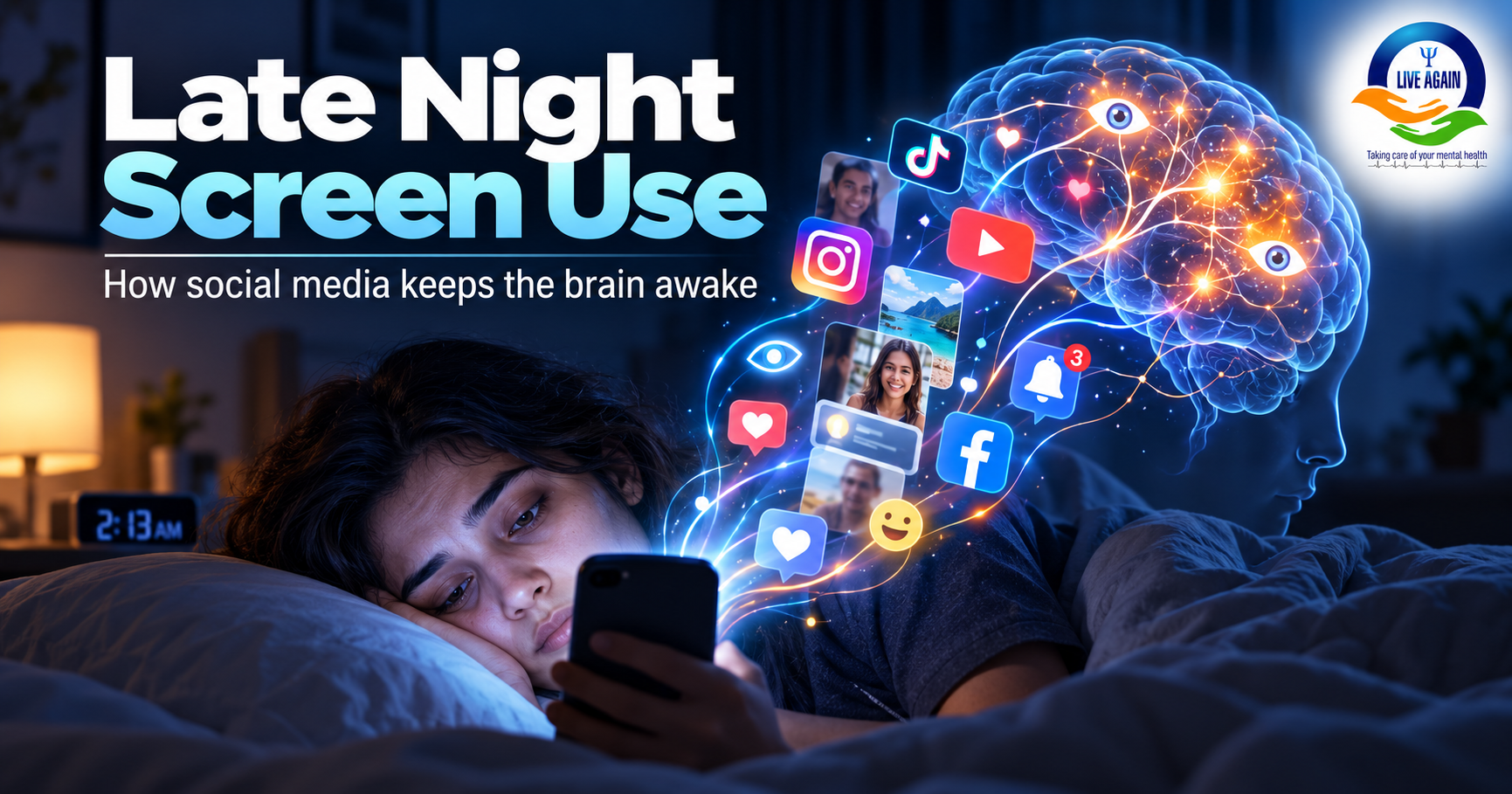
Human beings are highly responsive to faces and gaze. Eyes tell us where another person is looking. Facial expressions also carry information about emotion, intention and social relevance. An integrative review of affective eye contact describes evidence that direct gaze can increase affective and autonomic arousal. It also notes that responses vary with context, task and the way gaze is presented.
This does not mean that seeing eyes on a screen automatically causes insomnia. It does mean that a face is not just another neutral patch of colour. A close-up face looking toward the camera can carry social meaning and can orient attention more strongly than a static landscape or plain text.
When Digital Eyes Become More Salient
Modern social-media faces are often presented differently from ordinary face-to-face encounters. Close camera framing, beauty filters, stronger contrast, smooth facial textures, enlarged-looking eyes, direct-to-camera gaze, ring-light catchlights and exaggerated expressions can make the eye region visually prominent. AI-generated faces and edited thumbnails may intensify this effect further.
Here an important scientific boundary must remain clear. Research does not currently establish that “engineered eyes” themselves cause sleep disturbance. It would be premature to claim a direct pathway from digitally altered eyes to insomnia. The better-supported idea is that salient faces and gaze can capture attention and contribute to emotional or social engagement. That engagement may then become one part of a broader pre-sleep arousal pattern.
Late Night Screen Use: Direct Gaze Without Ordinary Social Closure
There is another psychological difference between real-life and digital interaction. In an ordinary conversation, eye contact occurs within a reciprocal sequence. We look, respond, notice the other person’s reaction, speak, regulate distance and eventually end the interaction.
On social media, a person may encounter dozens of faces apparently looking directly toward them, but there is no normal interpersonal endpoint. Swipe, and another face arrives. Swipe again, and another social signal appears. The brain keeps receiving socially meaningful material without entering a complete reciprocal exchange.
This is a psychological interpretation rather than a proven sleep mechanism. Still, it may help explain why a social-media feed can feel more compelling than a neutral page. Much of the feed is organised around people, expressions, reactions and anticipated responses.
Late Night Screen Use: Emotional Content Can Keep the Mind Awake
Not all screen content has the same psychological effect. A calm documentary, a work email, a relationship argument, political conflict, sexual content, health information, comedy and a message from someone emotionally important can produce very different levels of arousal.
A 2024 study of emerging adults found that greater emotional investment in social media and more frequent use were associated with poorer sleep quality and greater insomnia severity. The researchers also reported a pathway involving negative social comparison and pre-sleep cognitive arousal. Because the study was observational, it cannot prove causation. It does, however, show why the meaning of online activity may matter alongside the amount of time spent online.
This becomes especially relevant at night. A post may create envy, fear, attraction, anger, curiosity or uncertainty. Even after the phone is put away, the emotional reaction may continue. The screen has stopped producing light, but the mind may keep replaying what it has just seen.
Why “Just One More Reel” Becomes Difficult to Stop
Social-media feeds also contain a strong novelty component. We usually do not know what the next swipe will bring. It may be funny, attractive, personally relevant, alarming or completely uninteresting. That uncertainty encourages continued checking because each new item offers another possibility.
It is common to explain this entirely as a “dopamine addiction,” but that is too simplistic. Dopamine participates in learning and motivated behaviour. Scrolling also reflects habit, convenience, boredom, emotional regulation, novelty and social expectation. No single chemical explains the whole behaviour.
The practical consequence is easier to see than the molecular explanation. A feed without a natural ending makes stopping depend on an active decision. A book chapter ends. A television episode ends. Infinite scroll does not. When the person is already tired, the next swipe requires almost no effort while stopping requires a deliberate break in behaviour.
Social Connection, FOMO and the Need to Stay Available
Sometimes the person is not staying online because the content is exciting. They may be waiting for someone to reply, checking whether friends are still active, seeking reassurance, avoiding loneliness or fearing that something important will happen without them.
A qualitative systematic review of adolescents’ bedtime social-media experiences identified social motivations, habitual smartphone use and fear of missing out as recurring themes. These findings come from adolescents and should not automatically be generalised to every adult. Even so, they illustrate how digital communication can create a sense of social accountability and continued availability at bedtime.
This is another reason the evening phone habit cannot be understood only as a light problem. The device may be serving an emotional function. For one person it reduces loneliness. For another it distracts from worry. For someone else it maintains contact with an important relationship. If we remove the phone without understanding that function, scrolling may simply be replaced by rumination.
Why Oxytocin Is Not the Main Explanation
Oxytocin is relevant to social bonding, stress regulation and emerging research on sleep. However, it should not be used as a direct explanation for why social-media faces or eye contact disturb sleep. A systematic review of oxytocin-based sleep research found limited and mixed human evidence, while newer reviews still describe several sleep-social-oxytocin mechanisms as emerging. For this article, the stronger explanation remains attention, emotion, behavioural engagement, light exposure and delayed disengagement.
The Hidden Mechanism: Sleep Displacement
Sometimes the strongest mechanism is also the simplest. A person intends to sleep at 11:30 PM but scrolls until 12:45 AM. Even if the content produced no measurable physiological arousal, seventy-five minutes of sleep opportunity have already been displaced.
A 2024 theoretical review of sleep and technology describes bright light, arousal, nighttime disruption and sleep displacement as major pathways. It also emphasises a bidirectional relationship. People with sleep difficulties may use technology because they are already awake, bored, distressed or trying to regulate emotion. The phone can therefore be both a contributor to poor sleep and a coping response to an existing sleep problem.
This bidirectional view protects us from simplistic blame. Not every person who uses a phone at night develops poor sleep. Not everyone with insomnia needs a “digital detox.” The individual sequence matters.
When the Body Is Tired but the Brain Remains Engaged
This brings us back to the Two-Process Model discussed in our previous Live Again India article. Process S, or sleep pressure, may be high after a long day. At the same time, the person may still be receiving circadian light input, novel information, direct gaze, emotional content and social cues. The body can be tired while attention remains directed outward.
Late Night Screen Use can therefore create a mixed state. The body asks for rest, while the mind continues to monitor, interpret and respond. If the person also begins worrying about being awake, another layer of arousal is added. Tiredness alone is not always enough because sleep depends on timing, pressure, environment and the ability to disengage.
Does Everyone Need to Stop Screens Completely?
No single rule fits everyone. The effect of Late Night Screen Use depends on timing, duration, brightness, content, age, chronotype, existing insomnia and individual sensitivity. A 2024 systematic review and meta-analysis found associations between social-media use and sleep problems in younger populations. It also reported substantial heterogeneity across studies. Population-level associations do not mean every person is affected in the same way.
Experimental findings are not perfectly uniform either. A small 2024 laboratory study in adolescents compared 45 minutes of pre-sleep social media with smartphone reading and physical-book reading. It did not find a discernible worsening of measured sleep quality or pre-sleep arousal in that small sample. This finding does not prove that bedtime social media is harmless. It reminds us to avoid turning broad associations into universal claims.
A more useful question is personal and observable: what happens to your sleep with particular content at particular times? Does bedtime drift? Does your mind become more activated? Do notifications pull you back into wakefulness? These patterns provide better guidance than a rigid rule applied to everyone.
A Better Evening Digital Strategy
Managing Late Night Screen Use does not require digital perfection. The goal is to help the nervous system receive clearer signals that the active day is ending. A reasonably consistent wake time helps anchor the circadian system. In the later evening, reduce unnecessary brightness and avoid holding a bright screen close to the eyes for long periods.
Create a defined stopping point rather than relying on the feed to end itself. Disable non-essential nighttime notifications. When possible, move emotionally difficult conversations, work messages and highly activating content away from the period immediately before sleep.
If you use a device to relax, choose content with a natural ending: one article, one podcast segment, one saved video or a short playlist instead of an endless feed. Notice which content leaves you calmer and which leaves you mentally “open.” The most useful change may be the type and timing of content rather than treating the phone itself as the enemy.
When Late Night Screen Use Becomes Part of Insomnia
A screen habit can become embedded in a larger insomnia cycle. Someone cannot sleep, so they pick up the phone. The phone delays disengagement, and the person becomes more alert. They check the time, calculate the hours remaining, become anxious about tomorrow and return to the phone for distraction. Bedtime then becomes associated with monitoring, frustration and wakefulness.
The American Psychological Association describes cognitive behavioral therapy for insomnia, or CBT-I, as an evidence-based treatment for chronic insomnia. CBT-I works with the thoughts, behaviours and conditioning that maintain the problem. In such cases, the clinical target is not always “screen time.” It may be sleep-related fear, excessive time awake in bed, irregular scheduling, reassurance-seeking, emotional avoidance or conditioned arousal.
How a Therapist Can Help You
A therapist can help identify whether late-night screen use is mainly driven by habit, anxiety, loneliness, work pressure, reassurance-seeking, emotional avoidance, bedtime procrastination or an established insomnia cycle. Therapy can work with the function of the behaviour instead of simply blaming the device. CBT-I principles can be integrated when sleep anxiety and conditioned wakefulness are maintaining the problem. Medical or sleep-specialist assessment may also be appropriate when symptoms suggest another sleep or health condition.
Welcome to Live Again
Welcome to Live Again. Live Again India Mental Wellness is supporting you – you are not alone when evenings become dominated by scrolling, overthinking or difficulty switching off. Understanding what keeps the brain engaged is often more useful than blaming yourself for lacking discipline. With suitable behavioural changes, psychological support and medical or sleep assessment when needed, the transition from an active day toward healthier sleep can gradually become more predictable.
L@A
By Inderjeet Singh | Live Again India Mental Wellness