
When Thoughts Keep Returning: Why Your Mind Replays the Past
When Thoughts Keep Returning: A scientifically grounded exploration of rumination, repetitive negative thinking, and learning to return to the present.
At some point in life, most of us may have experienced this: an experience may end in real life, but it does not always end inside us. A conversation may be over, a person may have left, a decision may already have been made, or a difficult day may have passed. Yet the mind keeps going back. You remember the words again. You think about what you should have said. You wonder what the other person really meant. You ask yourself whether you made a mistake, missed a warning sign, or could somehow have changed the outcome. Sometimes these thoughts return while you are working, eating, driving, sitting quietly, or trying to sleep.
When Thoughts Keep Returning, it can feel as if one part of you is still standing in that old moment, hoping that one more round of thinking will finally bring an answer, explanation, or sense of closure. This is a deeply human experience. The mind is often not trying to trouble you; it may be trying to understand what happened, protect you from being hurt again, prepare you for the future, or make sense of something that still feels unfinished. The difficulty begins when this thinking stops helping and starts taking away your peace, attention, sleep, emotional energy, and ability to remain connected with the life that is happening in the present.
Why Repetitive Thoughts Return

Our brain naturally learns from experience. Looking back can help us understand what happened, notice a pattern, correct a mistake, or make a better decision next time. That is healthy reflection. But sometimes the mind keeps returning to the same event without finding anything new. When Thoughts Keep Returning, the event may feel unfinished because it still carries uncertainty, hurt, shame, guilt, anger, rejection, fear, or regret. The mind keeps opening the same memory because it believes there is still something important to solve.
This can feel useful at first. You may think, “If I analyse it properly, I will understand why it happened,” or “If I review every detail, I can stop it from happening again.” The intention makes sense. But repeated thinking can slowly become rumination. Rumination means repeatedly going over distressing thoughts, feelings, causes, or consequences without reaching a clear solution. The American Psychiatric Association explains that persistent negative rumination can be linked with anxiety and depression and can make emotional distress harder to manage. This does not mean that every repeated thought is a mental illness. It means we should notice whether the thinking is helping us or trapping us.
Reflection and Rumination Are Different
Reflection usually moves toward understanding or action. For example: “I became defensive in that meeting because I felt criticised. Next time I will slow down before I reply.” This gives you a lesson and a next step. Rumination is more circular: “Why did I say that? What must they think of me? Why do I always do this? What if I have ruined everything?” The mind keeps asking questions, but the questions do not create new clarity. When Thoughts Keep Returning, ask yourself a simple question: “Is this thinking helping me understand or act, or am I only repeating the same mental conversation?”
Another useful question is: “Can I do something practical about this?” Some problems can be acted on. You can apologise, send a message, ask for clarification, collect information, make an appointment, change a plan, or set a boundary. Other questions may never have a complete answer: “What did that person truly think of me?” “Would everything have been different if I had chosen another path?” “Why did someone change?” “Can I guarantee I will never be hurt again?” If the mind treats an unanswerable question as a problem that must be solved, it can stay busy for hours without actually helping you.
When Thoughts Keep Returning: What Is Your Mind Searching For?
Repeated thoughts often become easier to understand when we look beneath them. The mind may be searching for certainty: “Tell me exactly what happened.” It may be searching for control: “Show me how I could have prevented it.” It may be searching for reassurance: “Tell me I am still okay.” It may be searching for justice: “Help me understand why this happened to me.” Or it may be searching for safety: “Promise me this will never happen again.” When Thoughts Keep Returning, identifying the need under the thought can be more useful than answering every thought one by one.
This is especially common after betrayal, criticism, rejection, humiliation, conflict, or sudden change. The mind may keep replaying the event because the experience made life feel less predictable. Replaying can become an attempt to restore a sense of order. Understanding this helps us respond with less self-criticism. You can say, “My mind is trying to protect me,” while also recognising that endless review may not be giving you the protection you need.
When Thoughts Keep Returning: Uncertainty Can Keep the Mental Loop Alive

There is a strong connection between repetitive thinking and the need for certainty. In our recent Live Again India article When You Need Certainty, we discussed how the mind can become distressed when it demands guarantees before allowing us to feel safe. The same pattern can appear here. When Thoughts Keep Returning, the mind may be saying, “I cannot move on until I know exactly why this happened, what it means, and what will happen next.” But real life does not always provide complete answers.
Sometimes another person gives us closure through an honest explanation, apology, or clarification. Sometimes they cannot or will not. Sometimes their answer still does not feel enough. In such situations, recovery may require a different kind of closure: accepting what you know, accepting what you may never know, deciding what the experience teaches you about your needs or boundaries, and allowing your life to continue without a perfect explanation.
When Thoughts Keep Returning: Why Social Situations Replay So Easily
The mind often replays social moments because relationships and belonging matter to us. A short reply, an awkward sentence, being ignored in a group, a change in someone’s tone, or a mistake in front of others may seem small from the outside but feel very important inside. Later, the mind starts reviewing: “Did I embarrass myself?” “Were they offended?” “Did everyone notice?” “Should I explain myself again?”
This pattern can become stronger when a person is very self-critical, perfectionistic, socially anxious, or sensitive to rejection. It can also develop when someone has grown up in an environment where mistakes were heavily criticised. The mind then starts believing that social safety depends on getting everything right. But real relationships do not require perfect performance. People misunderstand each other, clarify, repair, apologise, learn, and sometimes accept that they cannot control how everyone sees them.
A practical question can help: “Is there something useful I need to do now, or am I reviewing the same evidence again?” If there is an action to take, take it. If no reasonable action remains, more mental review may only keep the emotional experience active.
When Thoughts Keep Returning: A Simple Neuropsychological Perspective
From a neuropsychological perspective, repetitive thinking does not come from one single “rumination area” in the brain. It involves communication between several brain networks. The default mode network is active when we turn inward, think about ourselves, remember personal experiences, or imagine situations. Other frontoparietal systems help us direct attention, make decisions, and shift from one mental task to another.
Brain-imaging research has found that repetitive negative thinking can be associated with patterns of activity and connectivity across these networks, particularly in depression and sadness. In simple terms, the brain can become repeatedly pulled back into an internal story while finding it harder to shift attention toward what is happening now. This does not mean that a person with repetitive thoughts having a “impairment in brain.” It means that attention, memory, emotion, and self-focused thinking can become strongly linked for a period of time. This is one reason why practical activities, movement, sensory grounding, structured attention, and therapy can help the mind shift out of the loop.
When Thoughts Keep Returning: Why “Just Stop Thinking” Usually Does Not Work
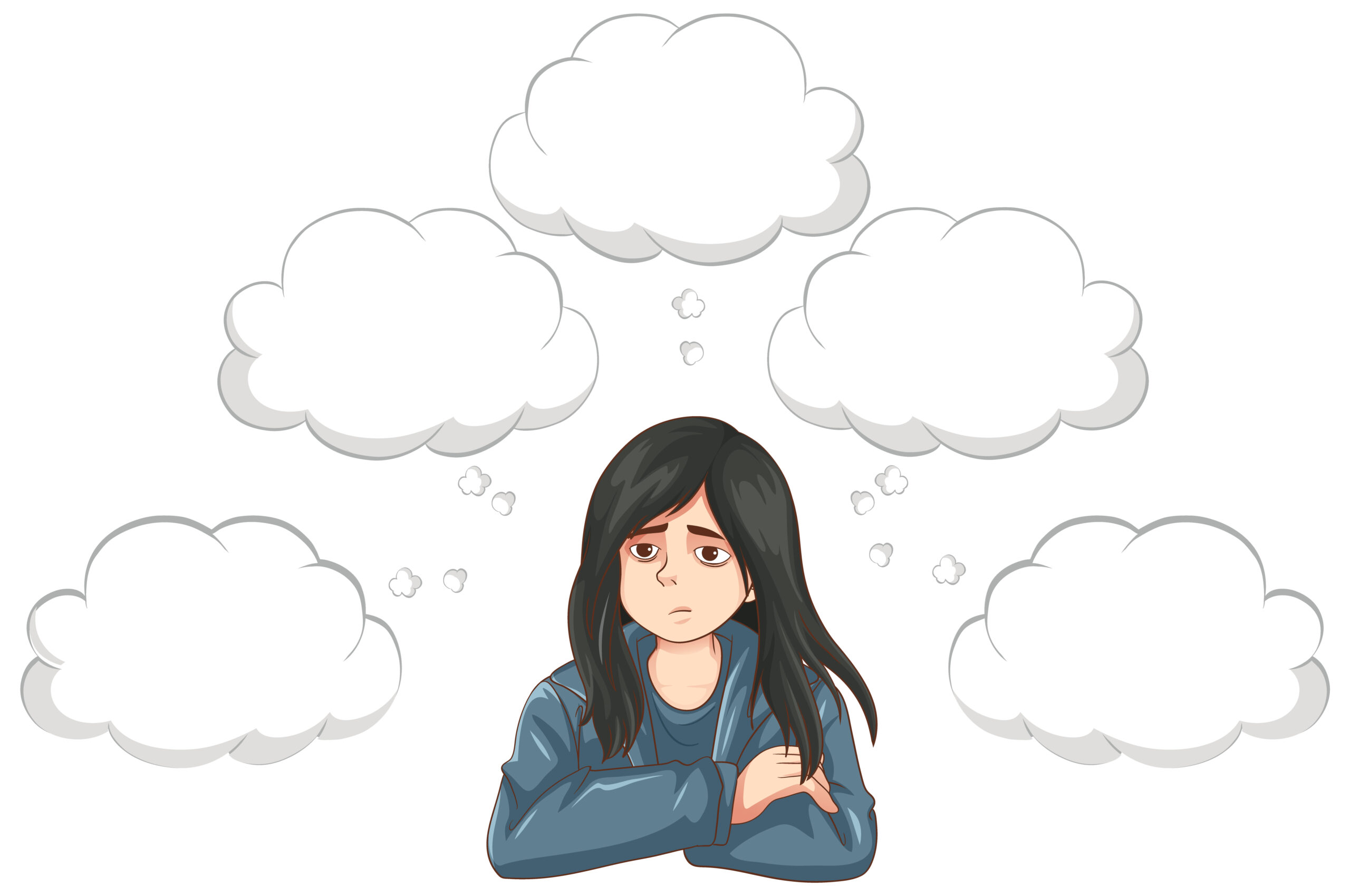
People often become frustrated and tell themselves, “Stop thinking about it.” But trying to force a thought away can make the mind check whether the thought is gone. That checking brings the thought back again. A more helpful response is to notice the thought without immediately entering it: “This thought has returned. I know this loop. I do not need to solve it again right now.”
This is not the same as suppressing emotion. If something has hurt you, the emotion may need space. You may need to talk, write, cry, grieve, reflect, or ask for support. The difference is between giving an emotion healthy space and turning the emotion into hours of repeated analysis. Feeling an emotion can help it move. Repeated mental investigation may keep it active.
When Thoughts Keep Returning: What You Can Do When the Loop Starts Again
The NHS Every Mind Matters guidance on tackling worries recommends useful strategies such as writing worries down, setting aside a specific “worry time,” separating problems that can be acted on from worries that cannot be solved immediately, and then returning attention to the present. These ideas are also useful for repetitive thinking. When Thoughts Keep Returning, the goal is not to win an argument with your mind. The goal is to respond differently when the thought returns.
I. Name What Is Happening
Instead of immediately entering the story, name the process: “I am replaying that conversation again,” “I am looking for certainty again,” or “I am reviewing the same mistake again.” Naming the process creates a small distance between you and the thought.
II. Ask Whether Any Action Is Needed
Ask: “Is there something reasonable I can do about this today?” If yes, choose the smallest useful step. Send the clarification. Make the appointment. Write the plan. Apologise. Gather the information. Set the boundary. If there is no useful action, recognise that more thinking may not be problem-solving.
III. Give Thinking a Time Limit
If the issue truly needs reflection, give it a defined space. Write about it for ten or fifteen minutes. Note what you know, what you do not know, and what you will do next. When the thought comes back later, remind yourself: “I have already given this attention. I can return to it at the time I decided.”
IV. Return to the Present Through the Body
Repetitive thinking can absorb attention so strongly that another thought is not always enough to interrupt it. Stand up. Walk for a few minutes. Stretch. Wash your face. Notice the room around you. Take slow, natural breaths. Complete one small physical task. When reasonable reflection is already done, returning to the body is not avoidance; it is a way of bringing your attention back to the present.
V. Replace Self-Criticism With Curiosity
Instead of asking, “What is wrong with me?” try asking, “Why did this matter so much to me?” The event may have touched an important need: respect, belonging, loyalty, competence, safety, love, or fairness. Understanding the need underneath the pain gives you something useful to care for in the future.
VI. Decide What Lesson Is Enough
The mind can keep searching for lessons forever. At some point, choose the lesson you want to carry forward. It may be: “I need clearer boundaries.” “I will ask instead of assuming.” “I cannot control another person’s honesty.” “I want to prepare better.” “One awkward moment does not define me.” The lesson can move forward with you. The whole replay does not need to.
When Thoughts Keep Returning: When Thoughts Become Louder at Night
Night often makes repetitive thinking louder because the day becomes quiet and there are fewer distractions. If possible, do not turn the bed into a place where every conversation is retried. Keep a notebook nearby and write the concern in one or two lines if you are afraid of forgetting it. Decide when you will review it the next day. Then return to sleep-supportive cues such as dim light, a familiar routine, quiet breathing, or neutral sensory attention.
If sleep difficulty is frequent, severe, or continues for a long time, it deserves separate attention. Poor sleep can reduce emotional resilience and make it harder to shift away from repetitive thinking. At the same time, worry and rumination can disturb sleep further. Both can be addressed gradually rather than waiting for one problem to disappear completely before working on the other.
When Repetitive Thinking Needs Professional Attention
Most people replay experiences sometimes, especially after loss, conflict, rejection, uncertainty, embarrassment, or important decisions. But When Thoughts Keep Returning for long periods every day, interfere with sleep or work, increase checking or reassurance-seeking, worsen anxiety or low mood, keep you trapped in guilt or self-blame, or follow a traumatic experience that still feels emotionally present, professional support may be helpful.
Professional support is especially important if repetitive thoughts include hopelessness, thoughts of self-harm, or thoughts of suicide. In that situation, the priority is not simply learning a technique to stop overthinking. The priority is timely assessment, safety support, and appropriate mental-health care.
Moving Forward Does Not Mean Forgetting
Sometimes people hold on to repeated thinking because moving forward feels like saying the experience did not matter. When Thoughts Keep Returning, releasing the loop can even feel like abandoning something important. But releasing the mental loop does not mean approving what happened, forgetting the person, denying the loss, or pretending you were not hurt. You can remember and still move. You can learn and still rest. You can keep a boundary without replaying the injury every day.
The past can remain part of your story without taking over the whole page you are living today. The goal is not to create a perfectly silent mind. The goal is to notice when thinking has stopped helping you understand and has started using up your attention. From there, you can gently choose where you want to place your attention next.
Today’s Reflection from the Therapy Room
Not every returning thought needs another answer. Sometimes peace begins when you understand what your mind is searching for, take the action that is actually possible, and allow yourself to return to the life happening now.
How a Therapist Can Help You
A therapist can help you understand why certain thoughts keep returning and whether the pattern is mainly linked with rumination, anxiety, stress, trauma, obsessive thinking, depression, or another emotional process. Together, you can identify triggers, work on unhelpful beliefs, learn attention-shifting and emotional-regulation skills, and build practical steps that improve daily functioning.
Therapy is not about telling you to “just stop thinking.” It is about helping you understand the pattern, respond to it more flexibly, and work through the experiences that continue to pull your mind back.
Welcome to Live Again
Welcome to Live Again. Live Again India Mental Wellness is supporting you – you are not alone. If your mind keeps returning to painful experiences, regret, uncertainty, or unanswered questions, you deserve a place where those experiences can be understood without judgement. With support, practice, and patience, you can learn to carry what happened without allowing it to take away every new moment. Your past matters, but your present life also deserves your attention, care, and hope.