Melatonin and Circadian Rhythm: How Modern Nights Confuse the Brain
Melatonin and Circadian Rhythm: There are nights when the body feels tired, but the mind does not seem ready to stop. You finish the day, lie down, pick up your phone “for five minutes,” and suddenly another hour has passed. You may feel physically exhausted, yet sleep feels delayed, lighter, or more fragmented than expected. Many people begin to interpret this as a failure of sleep itself. In my clinical understanding, a more useful question is often: what signals has the brain received during the hours before bedtime?
Melatonin and Circadian Rhythm are part of a larger biological system that helps the body distinguish day from night. Human sleep does not depend on one hormone, one brain region, or one bedtime routine. It emerges through the interaction of our internal circadian clock, the pressure for sleep that builds while we are awake, exposure to light and darkness, and the level of psychological arousal we carry into the night.
Understanding this system changes the question from “What can I take to make myself sleep?” to something more fundamental: “What signals is my brain receiving about the time of day?”
Time Never Sleeps, But Our Biological Body is Having a Rhythm With The Nature.
Melatonin and Circadian Rhythm: How the Brain Knows It Is Night
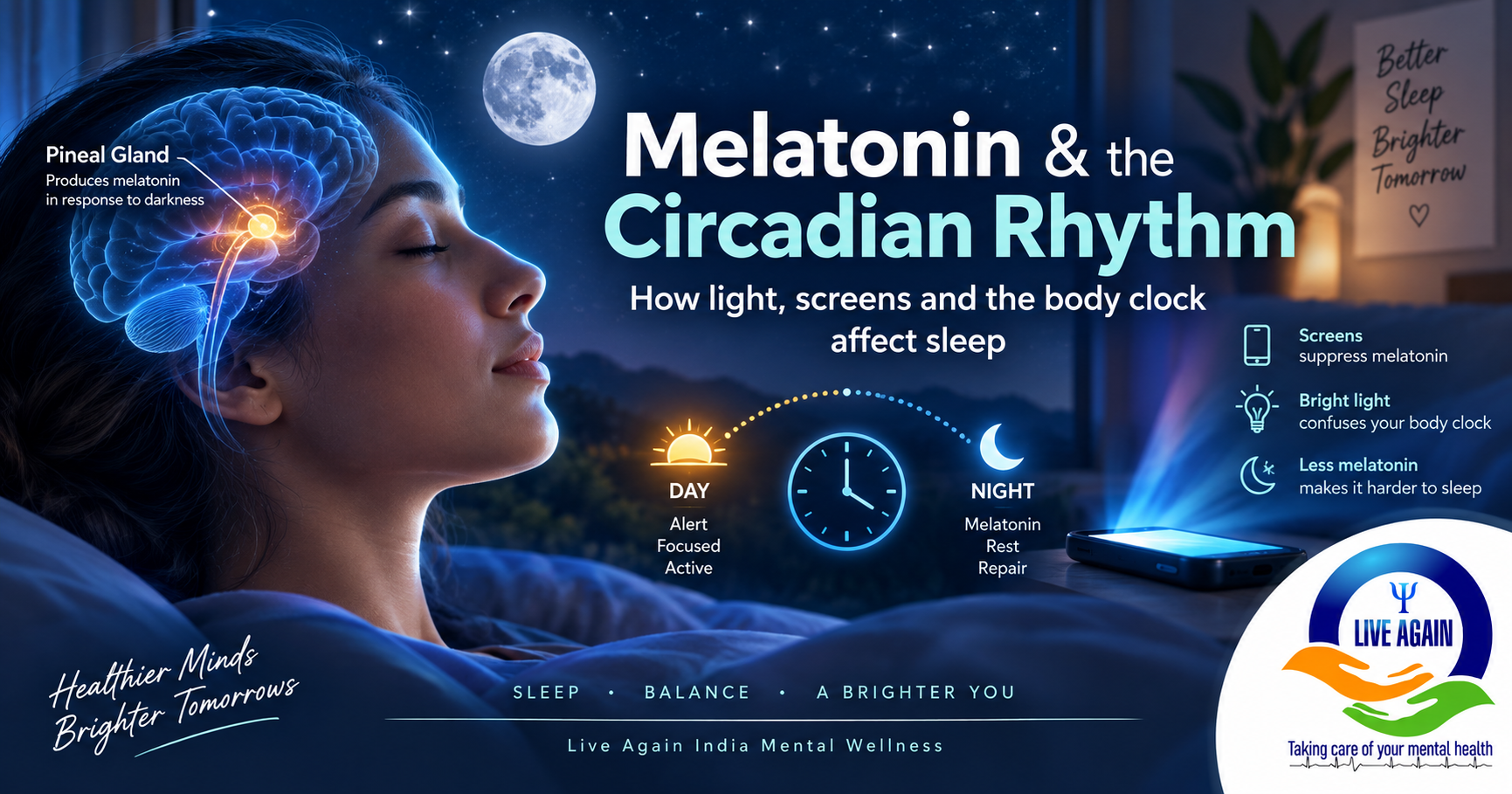
The circadian system is the body’s approximately 24-hour timing network. At its centre is the suprachiasmatic nucleus, or SCN, a small group of neurons in the hypothalamus. The SCN helps organise daily rhythms in sleep and wakefulness, alertness, hormone secretion, body temperature, and many other physiological processes.
Light is one of the strongest environmental signals that synchronises this clock. Specialised retinal cells known as intrinsically photosensitive retinal ganglion cells, or ipRGCs, contain the photopigment melanopsin. These cells do more than contribute to vision. They help measure environmental light and send that information through the retinohypothalamic tract to the SCN. Experimental work has shown that melanopsin-containing retinal ganglion cells are particularly sensitive to short-wavelength light in the blue-cyan part of the spectrum, although circadian responses depend on more than wavelength alone. PMC – melanopsin and non-image-forming visual responses.
From the SCN, information about light and darkness reaches the pineal gland through a multisynaptic pathway involving the paraventricular nucleus, spinal cord, and superior cervical ganglion. The human pineal gland does not itself “see” the light around us. Instead, it receives information about the external light-dark environment through this neural pathway.
During the biological day, light suppresses pineal melatonin production. As darkness develops and the circadian system moves into its night phase, melatonin secretion normally rises. That rise is one of the body’s internal signals that biological night has begun.
The Pineal Gland and the “Hormone of Darkness”
The pineal gland is a small endocrine structure in the posterior part of the brain. Its best-known secretion is melatonin, which is synthesised through a biochemical pathway that includes serotonin.
Calling melatonin simply a “sleep hormone” is convenient, but incomplete. A more useful description is the “hormone of darkness.” Melatonin secretion rises during the dark phase and helps communicate biological night to the rest of the body.
Melatonin and Circadian Rhythm therefore belong together conceptually. Melatonin does not function like an on-off switch that suddenly causes unconsciousness. Its major role in sleep biology is related to timing. It contributes to the physiological message that the internal night phase is underway.
The U.S. National Center for Complementary and Integrative Health, or NCCIH, describes melatonin as a hormone produced in response to darkness that helps with the timing of circadian rhythms and sleep. NCCIH also notes that exposure to light during the night can interfere with melatonin production. NCCIH: Melatonin – What You Need to Know.
Natural melatonin production is very small compared with typical supplement doses. Published estimates vary considerably between individuals, and nighttime concentrations also differ with age, circadian phase, laboratory technique, and other biological factors. Some reviews describe nocturnal serum concentrations around 80-120 pg/mL, but large studies of the literature also demonstrate substantial age-related and person-to-person variability. Therefore, one fixed number should not be treated as a universal “normal melatonin level.” PMC review of melatonin physiology.
Melatonin and Circadian Rhythm Are Only Part of Sleep
One common misconception is that sleep occurs simply because melatonin rises. Sleep science describes a much more coordinated process.
The classic two-process model of sleep regulation describes interaction between a homeostatic process and a circadian process. Sleep pressure gradually builds as we remain awake and reduces during sleep. At the same time, the circadian clock changes our biological tendency toward alertness and sleep across the 24-hour day. PMC – sleep homeostasis and circadian regulation.
This helps explain why someone can be tired yet remain alert at a biologically wake-promoting time, or why sleep at an unusual hour may feel different.
Melatonin and Circadian Rhythm are therefore important, but they operate inside this larger system. Melatonin cannot erase pain, environmental noise, stimulant use, irregular routines, worry, emotional activation, or persistent mental activity. Sleep is a coordinated biological and psychological state, not the product of one chemical.
What Modern Light Does to Biological Night
For most of human history, evening light was dim compared with daylight. Modern life has changed that environment dramatically. Bright indoor lighting, LED fixtures, televisions, tablets, laptops, and smartphones can extend significant light exposure long after sunset.
This does not mean that every screen is inherently harmful or that blue light should be feared. Circadian effects depend on brightness, spectrum, duration, timing, distance from the eyes, previous light exposure, and individual sensitivity.
Still, carefully controlled experiments show that evening electronic light can change circadian physiology. In a widely cited study by Chang and colleagues, participants spent four hours before bedtime reading either from a light-emitting electronic reader or a printed book. The light-emitting condition suppressed evening melatonin, delayed circadian timing by more than an hour, reduced evening sleepiness, and worsened next-morning alertness. PubMed – Evening use of light-emitting eReaders and circadian timing.
That laboratory experiment should not be interpreted to mean that ten minutes on every smartphone produces exactly the same effect. Rather, it demonstrates that sufficiently timed and sustained evening light can influence human circadian biology.
The message for Melatonin and Circadian Rhythm is therefore not, “Fear blue light.” It is, “Respect the timing power of light.”
The Screen Is More Than Light
A smartphone is not merely a small lamp held near the face. It is also a workplace, social environment, news source, shopping centre, entertainment system, gaming device, and pathway into emotionally charged information.
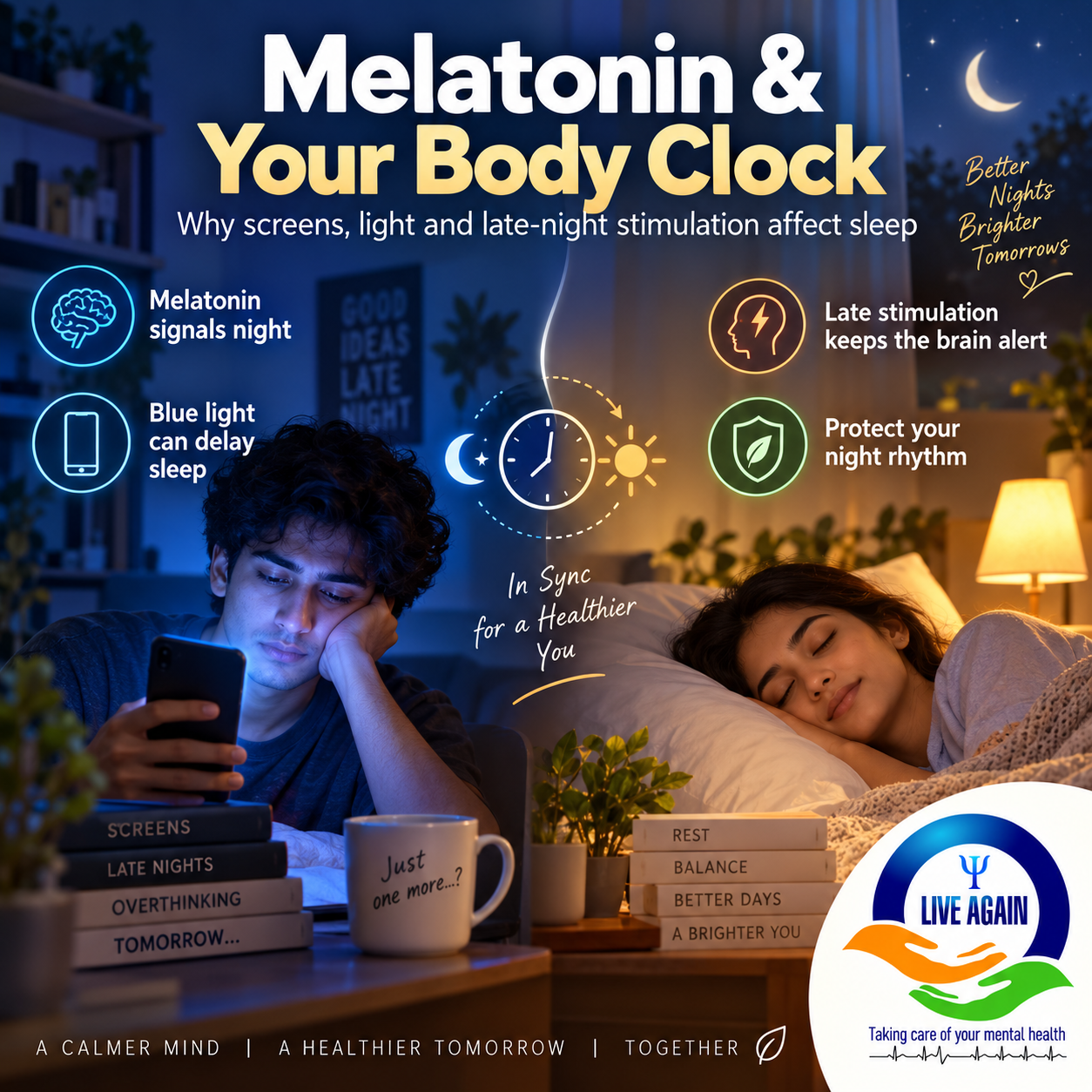
This matters because delayed sleep after screen use cannot be explained by light alone. One person stays awake because screen time simply displaces bedtime. Another becomes emotionally activated by a conversation. Someone else may be gaming, working, shopping, watching short videos, following news, or repeatedly checking social media.
The American Psychological Association has similarly highlighted that phones can interfere with sleep through several routes, including light, notifications, and highly engaging content such as news, social media, and work email. APA: Treating patients with chronic insomnia.
Psychologically, the brain can remain engaged in anticipation, reward-seeking, comparison, monitoring, threat detection, or problem-solving. Even when the room becomes dark, our behaviour may continue sending the message: the active day has not finished yet.
This is where circadian science and clinical psychology meet. Darkness can help the biological night emerge, but the mind also needs an opportunity to disengage from the psychological demands of the day.
Melatonin and Circadian Rhythm: Cognitive Arousal Can Keep the Night “Open”
In clinical work, people often describe being tired throughout the day and then mentally active as soon as they lie down. Once external demands become quiet, the mind starts reviewing tomorrow’s work, an unresolved argument, financial worries, health concerns, relationship uncertainty, or the question, “Why am I still awake?”
Trying to force sleep can itself become arousing. Repeated clock-checking, calculating how many hours remain, and monitoring the body for signs of sleep can gradually turn bedtime into a performance test.
Melatonin and Circadian Rhythm can support favourable biological timing, but they cannot resolve every form of cognitive arousal. The goal is not to create a completely empty mind. It is to reduce active problem-solving, emotional stimulation, and sleep-monitoring when the body is trying to move into rest.
The NHS also lists stress, anxiety, depression, alcohol, caffeine, nicotine, shift work, pain, medicines, and conditions such as sleep apnoea among factors that can contribute to insomnia. This is another reminder that persistent sleep difficulty needs broader assessment rather than being reduced to a melatonin problem. NHS: NHS guidance on insomnia.
Why Regular Timing Matters
The circadian system responds to repeated timing cues. Morning light, physical activity, meals, social routines, and sleep timing all help organise the biological day. A reasonably regular waking time can strengthen this pattern, particularly when followed by appropriate daytime light exposure.
This does not mean that everyone must follow the same timetable. Chronotype differs. Some people naturally function earlier and some later. Work schedules, caregiving responsibilities, illness, and age also influence sleep.
The aim is not rigid perfection. It is enough consistency for the brain to distinguish an active daytime period from a protected nighttime period.
Endogenous Melatonin Is a Signal, Not a Sleeping Pill
Endogenous melatonin is the melatonin produced naturally within the body according to circadian timing and environmental light. Its evening rise helps communicate that darkness and biological night have arrived.
Melatonin acts through receptors including MT1 and MT2, which are present in the SCN and other tissues. These G-protein-coupled receptors are involved in melatonin’s physiological effects and circadian regulation, although their functions are more complex than assigning one simple task to each receptor. Melatonin receptor: PubMed – melatonin receptors and circadian physiology.
This is why Melatonin and Circadian Rhythm should not be separated when explaining natural sleep. Timing is central.
A person whose melatonin begins to rise is not being chemically “knocked out.” Rather, the brain and body are moving into a physiological state in which sleep becomes more appropriately timed.
Exogenous Melatonin Is Different
Melatonin taken in a tablet, liquid, gummy, or other preparation is exogenous melatonin. It interacts with the same general receptor system, but taking melatonin from outside the body is not equivalent to the natural rhythm of pineal secretion.
Supplement doses are generally expressed in milligrams, whereas endogenous secretion occurs in much smaller quantities. Yet it would be misleading simply to compare those figures and say that a tablet is a fixed number of times “stronger.” Absorption, formulation, first-pass metabolism, dose timing, and individual pharmacokinetics determine how much reaches the circulation.
Immediate-release melatonin is also cleared relatively quickly, while oral bioavailability varies considerably between people. Published pharmacological reviews report that ordinary supplemental doses can generate circulating concentrations well above physiological nighttime levels. PMC – melatonin pharmacology and clinical use.
Most importantly, timing matters. Melatonin has chronobiotic properties, meaning that administration can alter circadian phase depending on when it is taken. Therefore, more melatonin is not automatically better, and a larger dose taken at an arbitrary time is not equivalent to correcting an altered circadian rhythm.
Melatonin and Circadian Rhythm: Supplements Need Context
Melatonin may be useful in particular circumstances, including certain circadian rhythm sleep-wake disorders and jet lag. But evidence is not identical for every complaint described simply as “I cannot sleep.”
Chronic sleep difficulty may instead be maintained by conditioned arousal, anxiety, irregular scheduling, medication effects, substance use, pain, mood disturbance, sleep apnoea, or other medical and psychological factors. Simply increasing melatonin may therefore miss the maintaining mechanism.
NCCIH reports that short-term use appears relatively safe for many people, while information about long-term safety remains limited. Reported short-term adverse effects include headache, dizziness, nausea, and sleepiness. Medicine interactions and individual medical factors also matter. NCCIH: Melatonin – What You Need to Know.
Supplement quality deserves similar caution. A 2023 JAMA investigation analysed 25 melatonin gummy products sold in the United States. Twenty-two were inaccurately labelled, and measured melatonin content ranged from 74% to 347% of the declared quantity. This was a particular U.S. sample and should not be generalised to every product or country, but it demonstrates why supplement content should not automatically be assumed to match the label. JAMA: Quantity of Melatonin and CBD in Melatonin Gummies Sold in the US.
The Contradiction of the Modern Bedtime
Consider a common contradiction. Someone takes melatonin at 10:30 PM while sitting under bright lighting, scrolling emotionally stimulating material, replying to work messages, and repeatedly checking whether the tablet has “started working.”
Biologically, one signal says: night. Behaviourally and psychologically, several other signals continue to say: stay active.
That does not make melatonin useless. It means the surrounding system matters.
Melatonin and Circadian Rhythm belong within an organised relationship between light, darkness, wakefulness, routine, and sleep opportunity. A supplement cannot fully recreate a predictable, psychologically quieter night.
Rebuilding a More Natural Night
Modern life cannot – and does not need to – return to a world without electricity or digital technology. The goal is not to fear screens. It is to develop better timing and healthier boundaries around the transition from day to night.
- Seek bright natural light earlier in the day, especially in the morning when possible.
- Keep waking time reasonably consistent instead of repairing every poor night through large schedule shifts.
- Reduce unnecessary bright light later in the evening and use softer lighting when practical.
- Reduce stimulating screen activity near bedtime, especially work, conflict, gaming, and endless scrolling.
- Do not treat “night mode” or blue-light filters as permission for unlimited late-night use; content and duration still matter.
- Create a brief wind-down period and write tomorrow’s next action down instead of trying to solve worries in bed.
- Keep the bed associated mainly with sleep rather than prolonged work, arguments, scrolling, or repeated sleep testing.
- Seek clinical evaluation when sleep problems persist, cause marked daytime impairment, involve breathing pauses, major mood changes, substance use, unusual sleep behaviour, or increasing reliance on medication or supplements.
The aim is not perfect “sleep hygiene.” It is to make the signals surrounding biological night more internally consistent.
Melatonin and Circadian Rhythm: What This Means for Mental Health
Circadian disturbance does not explain every mental-health problem, but sleep timing is closely connected with emotional regulation, attention, and daily functioning. Poor sleep can increase emotional reactivity, while anxiety, depression, trauma-related arousal, bipolar mood disturbance, substance use, and chronic stress can also disrupt sleep.
The relationship can run in both directions. The American Psychological Association describes sleep and mental health as bidirectionally related and notes that sleep disturbances commonly occur across conditions including anxiety, depression, PTSD, bipolar disorder, and schizophrenia. APA: The new science of sleep.
This is why Melatonin and Circadian Rhythm should not be reduced to a supplement conversation. Significant changes in sleep sometimes require us to examine biological rhythm, daily structure, psychological state, medication, substance exposure, and current life circumstances together.
A Better Question Than “How Do I Make Myself Sleep?”
Sleep is one of those human functions that often becomes harder when we try to force it directly. We can prepare for sleep, create suitable conditions, and reduce obstacles, but we cannot simply command unconsciousness to appear.
A better question at night may be: “What can I do now to make biological night easier for my brain to recognise?”
Sometimes that means dimming unnecessary light. Sometimes it means putting the phone aside. Sometimes it means deciding that tomorrow’s problem belongs to tomorrow. And sometimes it means accepting that one imperfect night does not need to become a psychological emergency.
Melatonin and Circadian Rhythm remind us that sleep is rhythmic. The body responds not only to what happens during the final ten minutes before bed, but to patterns repeated across the whole day.
How a Therapist Can Help You
A therapist can help when sleep difficulty is maintained by worry, rumination, bedtime anxiety, repeated checking, emotional stress, irregular routines, or a learned fear of not sleeping. Therapy can identify the cycle keeping the mind activated, help establish healthier cognitive and behavioural cues, and work alongside medical or sleep-specialist care when appropriate. Psychological approaches such as CBT-based insomnia treatment can address thoughts and behaviours that perpetuate wakefulness. The aim is not to force sleep but to reduce the conditions that keep wakefulness active. APA sleep-disorders: Sleep disorders and psychological treatment.
Welcome to Live Again
Welcome to Live Again. Live Again India Mental Wellness is supporting you – you are not alone when difficult nights, tired mornings, or a mind that refuses to switch off begin affecting everyday life. Sleep problems deserve thoughtful understanding and appropriate assessment rather than fear, shame, or repeated self-medication. With better understanding, healthier rhythms, and suitable professional support, the relationship between your mind, body, and night can gradually become steadier again.
L@A
By Inderjeet Singh | Live Again India Mental Wellness