
Understanding Pain and Suffering: Physical and Emotional Pain
Understanding Pain and Suffering: Every human life carries moments that hurt. Sometimes the pain is visible – a wound, an illness, a migraine, or a body struggling to function. At other times, no injury can be seen, yet something inside the person feels deeply wounded. The loss of someone loved, rejection by a close relationship, betrayal, humiliation, loneliness, or the collapse of an important dream may leave a person hurting in ways that are difficult to explain and equally difficult for others to recognise.
Therefore begins with more than the question, “Where does it hurt?” Human beings experience pain through the body, but also through memory, relationships, identity, belonging, and the meaning they give to what has happened. Physical pain and emotional pain are not identical, yet both can affect the whole person. A bodily condition may disturb confidence, independence, and hope, while emotional pain may be felt through sleeplessness, heaviness, exhaustion, tension, or a profound sense of inner emptiness.
This article explores physical pain, emotional pain, and suffering as related but distinguishable human experiences. Its purpose is not to offer a therapeutic programme or a list of coping techniques, but to understand what these experiences mean. Pain may arise in the body, in the emotional and relational world, or in both at the same time. Suffering develops when that pain begins to threaten something deeply important—our dignity, relationships, identity, sense of control, meaning, belonging, or hope for the future.
Understanding Pain and Suffering Across Body and Inner Life

The words pain and suffering are often used as though they mean the same thing. Sometimes this is reasonable because both describe distress. At other times, the distinction matters. Pain can refer to an immediate sensory and emotional experience, while suffering refers more broadly to what that pain, loss, or threat does to the person’s life and sense of self.
This distinction is not a rigid separation between body and mind. Physical pain already includes an emotional dimension, and emotional pain is often embodied through sleep disturbance, heaviness, agitation, fatigue, appetite change, chest tightness, or reduced concentration. The human organism does not divide experience as neatly as ordinary language sometimes suggests.
What Is Physical Pain?
The International Association for the Study of Pain defines pain as an unpleasant sensory and emotional experience associated with, or resembling that associated with, actual or potential tissue damage. This definition is important because it makes two points at once: pain is connected with bodily threat, but it is never only a mechanical signal from tissue.
The National Institute of Neurological Disorders and Stroke explains pain through biological, psychological, and social contributors. Attention, fear, memory, expectations, previous experience, relationships, and the surrounding environment can influence how pain is perceived. Recognising these influences does not make physical pain imaginary; it shows that pain is produced and understood through a living nervous system within a particular human life.
What Is Emotional Pain?
Emotional pain is an everyday and psychological expression for the distress associated with experiences such as rejection, grief, abandonment, betrayal, shame, guilt, humiliation, loneliness, failure, helplessness, or the collapse of an important dream. Unlike a cut or fracture, it may not have a visible location, but its absence from a scan does not make it unreal.
Emotional pain often appears when something personally significant has been damaged or lost. A person may lose a loved one, a relationship, trust, social standing, professional identity, a hoped-for future, or the belief that a family relationship was safe. The pain lies not only in the event but in what the event means: “I no longer belong,” “I was not valued,” “My future has changed,” or “The person I trusted was not who I believed.”
Research on social rejection has found overlap between aspects of physical-pain and social-pain processing. A widely cited neuroimaging study available through PubMed reported shared activation in certain regions when participants recalled rejection and experienced physical pain. This does not mean that rejection and bodily injury are identical. It supports the more careful conclusion that the brain can treat social disconnection as a significant threat rather than as a merely abstract idea.
The Body Can Carry Emotional Pain: Understanding Pain and Suffering
The National Institute on Aging describes grief and mourning as responses that can include sorrow, numbness, shock, and fear. Grief is therefore not only a thought about loss; it is a whole-person reaction that may affect attention, energy, relationships, bodily rhythms, and the ability to imagine life continuing in the same way.
Live Again India has explored related experiences in Relationship Stress In Men, where hurt, fear, loneliness, and emotional confusion may remain largely unspoken, and in Emotional Numbness Recovery: From Numb to Alive, where the mind may reduce access to feeling when emotional experience becomes overwhelming. These states are different, but both show that emotional pain may be present even when outward functioning continues.
Physical and Emotional Pain Overlap, but They Are Not Identical
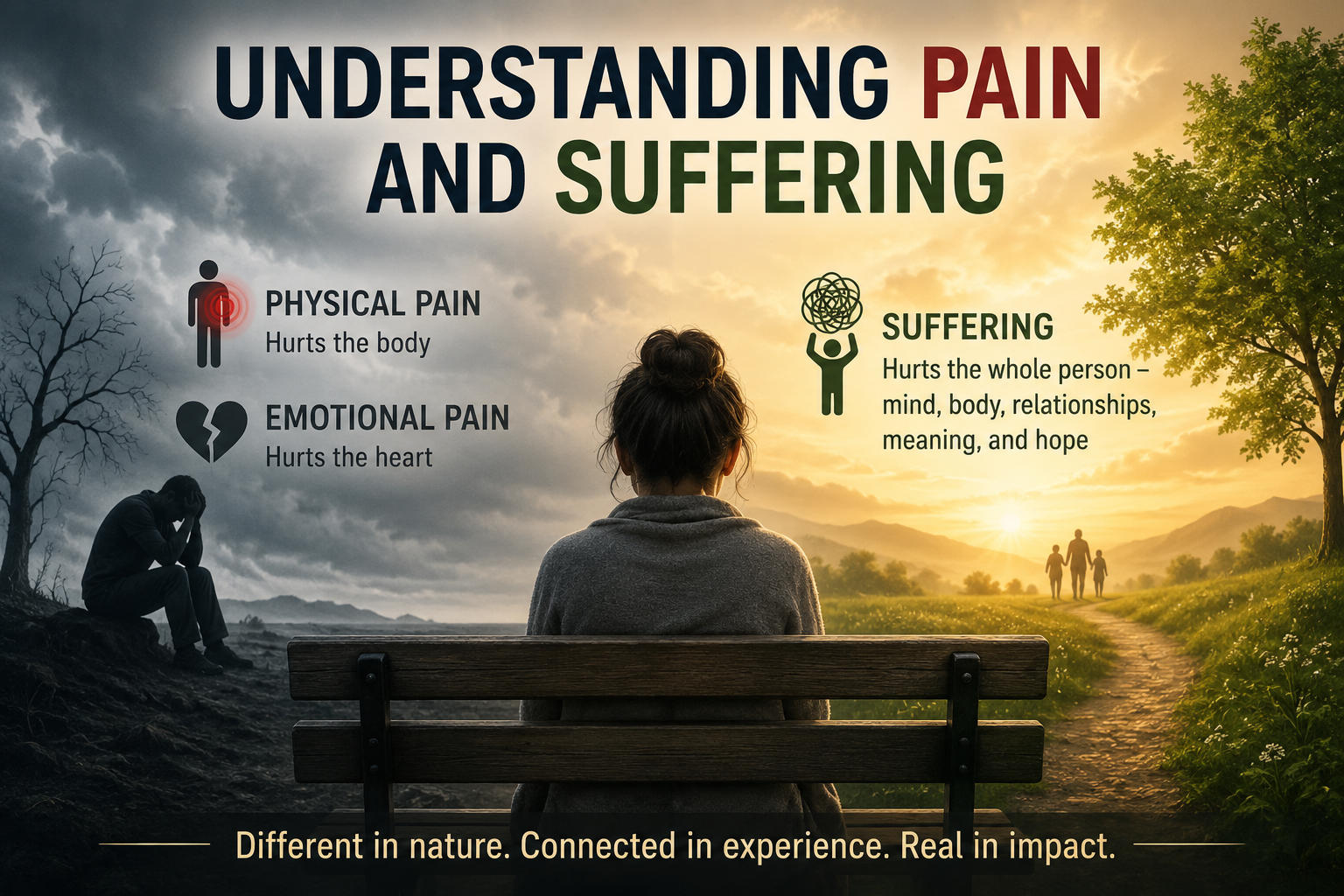
The overlap between physical and emotional pain should not be used to erase their differences. Physical pain is commonly organised around bodily sensation and perceived tissue threat. Emotional pain is commonly organised around meaning, attachment, identity, loss, memory, and social experience. Either can influence the other, but one should not automatically be reduced to the other.
A person living with persistent physical pain may also feel grief for lost mobility, fear about work, anger at dependence, or shame about needing help. A person living with emotional pain may develop bodily tension, poor sleep, exhaustion, or gastrointestinal discomfort. The first situation begins more visibly with the body; the second begins more visibly with the emotional or relational world. In both, the whole person becomes involved.
Understanding Pain and Suffering: What Is Suffering?
Suffering is broader than pain intensity. It arises when pain, loss, illness, threat, or helplessness is experienced as an assault on the person’s integrity. The person may feel that identity, dignity, independence, belonging, moral worth, purpose, or future has been damaged. Suffering therefore involves the relationship between an event and the meaning the person gives to that event.
A classic whole-person account of suffering describes it as distress linked with a threat to the intactness of the person. Research on healing published through PubMed Central similarly emphasises that healing and suffering involve personal meaning, wholeness, identity, and life narrative—not merely the removal of symptoms. This perspective helps explain why suffering can continue even after a wound has healed, and why a person with serious illness may still retain dignity, connection, and meaning.
When Physical Pain Becomes Suffering
Physical pain may become suffering when it begins to dominate the person’s identity and future. The distress may no longer be limited to the painful body part. It may include the loss of work, reduced independence, inability to care for family, uncertainty about recovery, financial pressure, disbelief from others, or fear that life will permanently shrink.
Two people can report similar pain intensity yet experience different suffering. One may understand the cause, trust the medical plan, retain social support, and continue to recognise several valued roles. Another may experience the same symptom as evidence that the body is failing, the family is burdened, employment is threatened, and no one believes the experience. The sensory pain may be similar; the personal meaning is not.
When Emotional Pain Becomes Suffering
Emotional pain becomes suffering when the event begins to reorganise the person’s understanding of self and world. Rejection may become “I am unlovable.” Betrayal may become “No relationship is safe.” Failure may become “My entire life has no value.” Humiliation may become “I cannot face people again.” The suffering lies in the expansion from a painful event to a total conclusion about identity or future.
Family and relationship experiences are especially powerful because belonging is central to human life. Repeated criticism, emotional pressure, silence, comparison, or invalidation can produce pain that is difficult to explain to others. Live Again India has discussed how concern may become pressure in Parental Concern Becomes Pressure and how adult relationships may require respectful limits in Setting Boundaries With Parents. These themes are relevant here because emotional pain often develops where love, duty, fear, and autonomy become entangled.
Not every painful emotion becomes lasting suffering. Sadness, disappointment, anger, guilt, and grief may remain painful yet still exist within a life that contains connection, purpose, and movement. Suffering becomes more pervasive when the pain appears to define the whole person or close every meaningful future possibility.
Understanding Pain and Suffering: Pain Without Severe Suffering
Pain can exist without overwhelming suffering. A person may experience bodily discomfort while understanding its cause and retaining confidence, support, identity, and hope. Another person may feel grief after a loss while also remaining connected to love, memory, community, and purpose. The pain is real, but it has not occupied the entire inner world.
It is also possible to function while suffering. People may work, parent, smile, study, and fulfil responsibilities while carrying intense emotional or physical pain. Outward performance cannot be treated as a reliable measure of inner experience.
Suffering Without Obvious Physical Pain
Suffering can exist without an identifiable bodily injury. Bereavement, infertility, displacement, social exclusion, unemployment, moral injury, loneliness, public shame, relationship loss, loss of faith, or loss of purpose can threaten the person’s continuity and belonging. There may be no visible wound, but the future may feel altered and the self may feel fragmented.
Some losses are socially recognised; others are not. A death may receive rituals and condolences, while the end of a friendship, miscarriage, estrangement, career collapse, or loss of a hoped-for identity may remain private. When suffering is not recognised, the person may carry both the original pain and the additional burden of feeling that the pain is illegitimate.
Understanding Pain and Suffering therefore requires attention to invisible losses. The absence of a medical diagnosis does not prove the absence of distress, just as the presence of a diagnosis does not tell us how much a particular person is suffering.
Illness and Disease: A Supporting Distinction
Disease generally refers to a pathological or physiological abnormality identified through clinical assessment, tests, or established criteria. Illness refers to the person’s lived experience of feeling unwell and the meaning of that experience. The concepts overlap, but they are not interchangeable.
A disease may be present before a person feels ill, as can occur with some asymptomatic conditions. A person may also feel profoundly unwell even when current investigations have not yet identified a clear pathology. Neither situation should be simplified into “real” versus “imagined.” Disease concerns identified pathology; illness concerns lived experience.
Understanding Pain and Suffering: Meaning, Identity, Culture, and Recognition

Human beings do not experience pain outside culture and relationships. Families differ in what they consider acceptable expression. Some encourage open communication; others value endurance, silence, faith, self-control, or duty. Gender expectations may shape who is allowed to cry, ask for help, or acknowledge vulnerability. These influences affect how pain is expressed, interpreted, and recognised.
Language can either preserve or damage dignity. Statements such as “You are overreacting,” “Others have it worse,” or “Nothing is wrong in the reports” may intensify suffering because they challenge the person’s credibility. At the same time, language that assumes catastrophe can also narrow identity. Conceptual accuracy requires neither dismissal nor exaggeration.
A whole-person interpretation asks several questions: What has been lost? What meaning does the person assign to the event? Which roles or relationships feel threatened? What remains intact? What future now seems impossible? The answers reveal why apparently similar events can produce very different experiences.
Understanding Pain and Suffering Without False Separation
Understanding Pain and Suffering requires us to hold three ideas together. First, physical pain is a genuine bodily and emotional experience. Second, emotional pain is genuine distress arising from loss, threat, rejection, shame, grief, or disrupted belonging. Third, suffering is the broader disturbance that occurs when either form of pain begins to affect the person’s wholeness, identity, dignity, meaning, or hope.
The categories help us think clearly, but real life often crosses their boundaries. A bodily illness may create emotional grief. A relational loss may be felt throughout the body. Emotional numbness may protect the mind from unbearable feeling while also reducing joy and connection. The whole person remains the meeting place of body, emotion, memory, relationship, culture, and future.
This interpretation also protects against a hierarchy of pain. Physical pain is not automatically more legitimate because it is visible, and emotional pain is not automatically deeper because it concerns the inner world. Each experience deserves accurate language and recognition within its own context.
Today’s Reflection from the Therapy Room
Understanding Pain and Suffering reminds us that the statement “I am in pain” may carry several meanings. It may refer to the body, to a relationship, to grief, to shame, or to the fear that life will never return to what it was. The most important difference is not always between physical and emotional pain, but between an experience that hurts and an experience that begins to threaten the whole person. A human being is never only a symptom, an event, or a diagnosis.
How a Therapist Can Help You Understand the Experience
A therapist can help a person describe the difference between bodily pain, emotional pain, illness, grief, and suffering without reducing the experience to a label. The therapeutic space can examine how personal history, relationships, culture, identity, and meaning shape what the experience represents. Understanding Pain and Suffering in this way does not deny medical reality or promise that every difficulty will disappear. It offers a fuller language for recognising the person who is living through the experience.
Welcome to Live Again India Mental Wellness
Welcome to Live Again. Live Again India Mental Wellness recognises that physical pain, emotional pain, and suffering may touch different parts of a person’s life, yet each deserves dignity and careful understanding. Your experience is not made unreal because others cannot see it, and your identity is larger than any painful event or diagnosis. Live Again India Mental Wellness is supporting you—you are not alone.