
When Happiness Becomes Conditional: The Life We Keep Postponing
There is something I have noticed in the way we talk about our lives. We are working, raising our children, looking after parents, managing relationships, trying to remain financially secure, and doing our best to handle the responsibilities that come with every stage of life. Still, when someone asks us whether we are happy, our answer often begins with a condition. “Once this problem is over.” “When things settle at home.” “After I achieve what I have planned.” It sounds reasonable because the problems are real. But have we ever considered how much of our life we are keeping on hold while waiting for that particular day? Lets understand the psychology behind When Happiness Becomes Conditional.
I would like us to look at this carefully. When Happiness Becomes Conditional, we may not stop living or fulfilling our duties. We continue doing almost everything that is expected of us. What changes is our relationship with the present. We allow ourselves to experience relief only when the circumstances agree with the picture we have created in our mind. And because life rarely arranges itself exactly according to our expectations, the waiting can become very long.
Today’s Reflection From the Therapy Room
In psychological practice, people often speak about a future point at which they believe they will finally be comfortable. Someone may want a relationship to become peaceful. Another may be waiting for an opportunity in their career. A parent may be worried about a child becoming independent. A person dealing with illness may be waiting for the next medical report. These are ordinary human concerns, and we should not minimise them.
But while listening, I think another question becomes important: what is happening to the person during this waiting period? Are they still able to enjoy a meal, speak openly with someone they trust, get some rest, learn something, or appreciate a small improvement? Or has every part of their emotional life become dependent upon the one thing that is not yet resolved? These are general reflections drawn from psychological work, not the story of any particular client.
How a Reasonable Expectation Becomes an Emotional Condition

When Happiness Becomes Conditional: Let us understand the difference between an expectation and a condition. It is natural to expect that our relationships should be respectful, our work should provide stability, and our efforts should produce some result. We need goals; they give direction to our behaviour. A condition is different. It begins when we tell ourselves, “Unless this happens, I cannot feel okay.”
When Happiness Becomes Conditional, the mind starts treating satisfaction as a reward that must be earned only after every difficulty has been corrected. But human life is not an examination where we must complete all the questions before we are allowed to feel at ease.
There Is Nothing Wrong With Wanting Life to Improve
I want to make one point very clear. We should not confuse psychological flexibility with accepting everything as it is. If someone is living with violence, severe financial insecurity, untreated illness, humiliation, or a serious family crisis, they need protection, appropriate treatment, practical decisions and support. Telling them to “just be happy” would be insensitive and, in some situations, unsafe.
The Endless Cycle of “After This, Then I Will…”
Consider a familiar pattern. A student thinks happiness will begin after the examination. Once the examination is over, the attention moves to the result. After the result comes admission, then a job, then salary, then promotion. Each achievement matters, but the mind keeps moving the finishing line. Something similar happens in family life: after the child settles, after the house is arranged, after the business becomes stable, after everyone agrees.
Psychological research offers a useful caution here. In studies by Mauss and colleagues on the paradoxical effects of valuing happiness, placing excessive pressure on ourselves to feel happy was linked with less positive emotional experience in particular circumstances. This does not mean wanting happiness is harmful. It means turning happiness itself into a strict performance target can sometimes work against the experience we are trying to create.
What Happens to Our Present Life
When our attention remains attached to a future condition, ordinary moments can begin to look unimportant. Eating with the family becomes another responsibility. Going for a walk feels like time taken away from work. Rest may produce guilt. Even a pleasant conversation becomes difficult because part of the mind is still occupied with an unresolved issue.
When Happiness Becomes Conditional, small opportunities for connection, learning and recovery may be repeatedly postponed. Over time, the person can become exhausted not only by the problem itself, but by the constant mental demand that the problem must disappear before life can resume.
The Mind Wants Certainty Before It Allows Peace
Many of us feel more comfortable when we know what will happen next. We want our relationships to remain predictable, our children to make suitable decisions, our careers to be secure and our plans to work. But life includes uncertainty, even when we have prepared carefully. If peace depends upon complete certainty, we may keep searching for reassurance without reaching a lasting sense of comfort.
The NHS explanation of cognitive behavioural therapy describes how people can learn to examine unhelpful interpretations and explore different ways of responding. In ordinary language, this means we do not have to accept every prediction of the mind as the final truth. We can ask: “What exactly has happened? What am I assuming? Is there something useful I can do today?”
When Happiness Becomes Conditional in Relationships

Sometimes the condition is connected with another person. We may think, “I will feel happy once my partner understands me,” or “I will be peaceful when my parents stop criticising me.” The wish for understanding is legitimate. Relationships are important, and emotional neglect or repeated conflict can cause real suffering.
But another person’s feelings and behaviour are not entirely under our control. If our emotional stability is dependent upon obtaining a particular response every day, we may spend enormous energy explaining, checking, persuading and waiting. We can communicate our needs, maintain healthy boundaries, seek support and make choices about the relationship. Yet we cannot produce another person’s agreement simply by worrying about it for longer.
When Happiness Becomes Conditional at Work
Professional and financial responsibilities carry their own pressure. Someone who is building a career may feel that every free hour should be used productively. Someone supporting a family may feel uncomfortable spending even a little time on personal enjoyment. A person who has faced setbacks may believe they must first recover every loss before allowing themselves to relax.
I respect the seriousness of these responsibilities. Financial planning, work discipline and accountability are necessary. Still, we should ask whether working continuously without recovery is actually improving our ability to function. A tired mind may become less patient at home, less focused at work and more vulnerable to repetitive worry. Taking a reasonable break is not the opposite of responsibility. Sometimes it is part of carrying responsibility well.
When Happiness Becomes Conditional, we may begin to judge rest as a luxury and ordinary happiness as something undeserved. That is a belief worth examining, rather than a law we must follow.
Happiness Is Not a Continuous Feeling of Pleasure
I think we also need to understand what we mean when we use the word happiness. If we expect life to provide excitement, satisfaction and positive feelings at every moment, we are setting an impossible condition. A meaningful life also includes tired days, disagreements, uncertainty, disappointment and grief. We do not have to remove all of these experiences to recognise that some aspects of our life are still worth living and appreciating.
The World Health Organization’s description of mental health includes our capacity to cope with life’s stresses, realise our abilities, work and participate in community life. This wider understanding is important. Emotional wellbeing is not simply the absence of difficulty or the presence of constant pleasure. It includes our ability to function, connect, recover and make choices within real circumstances.
Returning to Today Without Giving Up on Tomorrow
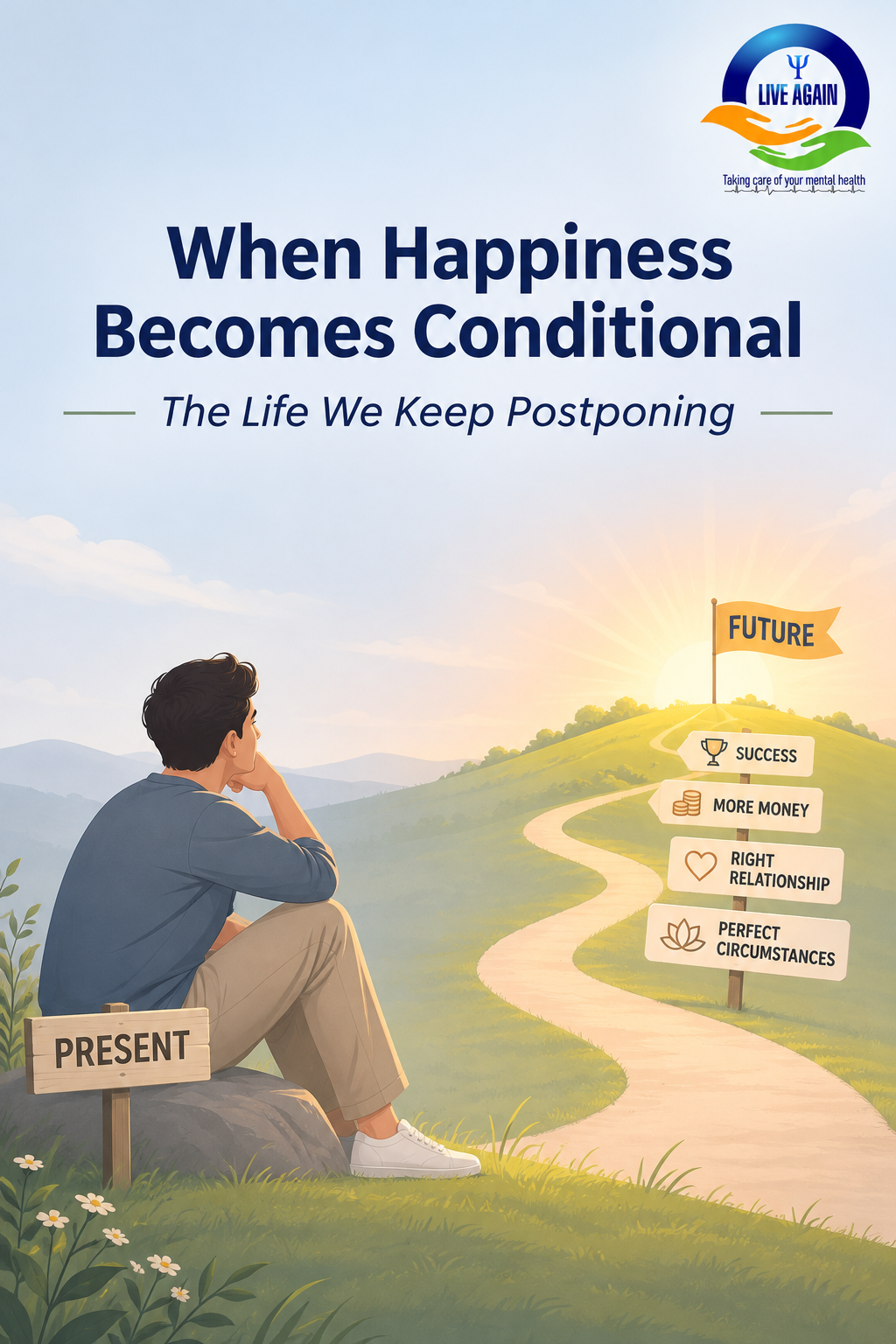
So, what can we begin doing differently? First, identify the condition you have quietly placed upon your happiness. Complete the sentence honestly: “I will allow myself to feel better only when…” There may be a person, a result, a financial figure, an apology, a medical update or a particular change in the family. Once it is visible, we can consider whether it is a genuine requirement for safety or an expectation that has expanded too far.
Second, separate the problem from the whole of your life. If a medical appointment is due, arrange it. If a conversation is necessary, prepare for it. If money needs attention, review the numbers. These actions are important. But after doing what is possible for the day, notice whether you are able to return to other parts of life. A problem may remain unfinished without requiring every hour of the day to be spent inside it.
Third, make room for small experiences that belong to the present. A meal without checking the phone. An honest conversation. A little reading. Time with a child without turning it into an assessment of their future. A walk that is not another target to achieve. Sleep without first solving every question in the mind. None of these activities will automatically correct a serious difficulty. Their value is that life does not have to become entirely organised around the difficulty.
The NHS guidance on behavioural activation explains the importance of reconnecting activity and mood, particularly where withdrawal has become part of depression. This is not a suggestion that everybody needs a depression intervention. It is a practical reminder that meaningful experiences often need a place in our routine rather than being left to happen only after we already feel better.
We Can Work Toward a Better Future and Still Live Today
Another helpful approach comes from Acceptance and Commitment Therapy, described by the Association for Contextual Behavioral Science. Its emphasis on values and psychological flexibility reminds us that a person can take meaningful action while difficult thoughts and feelings are still present. We need not wait until the mind becomes completely quiet before making a responsible choice.
When Professional Support May Be Needed
When Happiness Becomes Conditional is not a clinical diagnosis. If someone has stopped enjoying almost everything, cannot manage sleep or daily functioning, has persistent hopelessness, severe anxiety, or feels trapped in a harmful environment, it is important to look beyond everyday advice. Sometimes depression, anxiety, trauma, burnout or another medical or psychological difficulty may be involved. These possibilities need careful assessment, not a label based on one article.
How a Therapist Can Help You
A therapist can help you understand what you have begun expecting from life, relationships and yourself. Together, you can separate difficulties requiring action from thoughts that keep repeating without a solution. Therapy can help you develop emotional regulation, healthy boundaries, practical routines and meaningful experiences. It does not promise constant happiness; it supports your ability to live more fully while working through real problems.
Welcome to Live Again India Mental Wellness
Welcome to Live Again India Mental Wellness. We understand that life may be difficult even when you are doing your best. If expectations, uncertainty or emotional distress are making daily life difficult, you deserve to be heard with respect and supported with appropriate care. Your life is precious. Whatever situation you are facing, you are not alone. We are with you.
L@A
By Inderjeet Singh | Live Again India Mental Wellness