

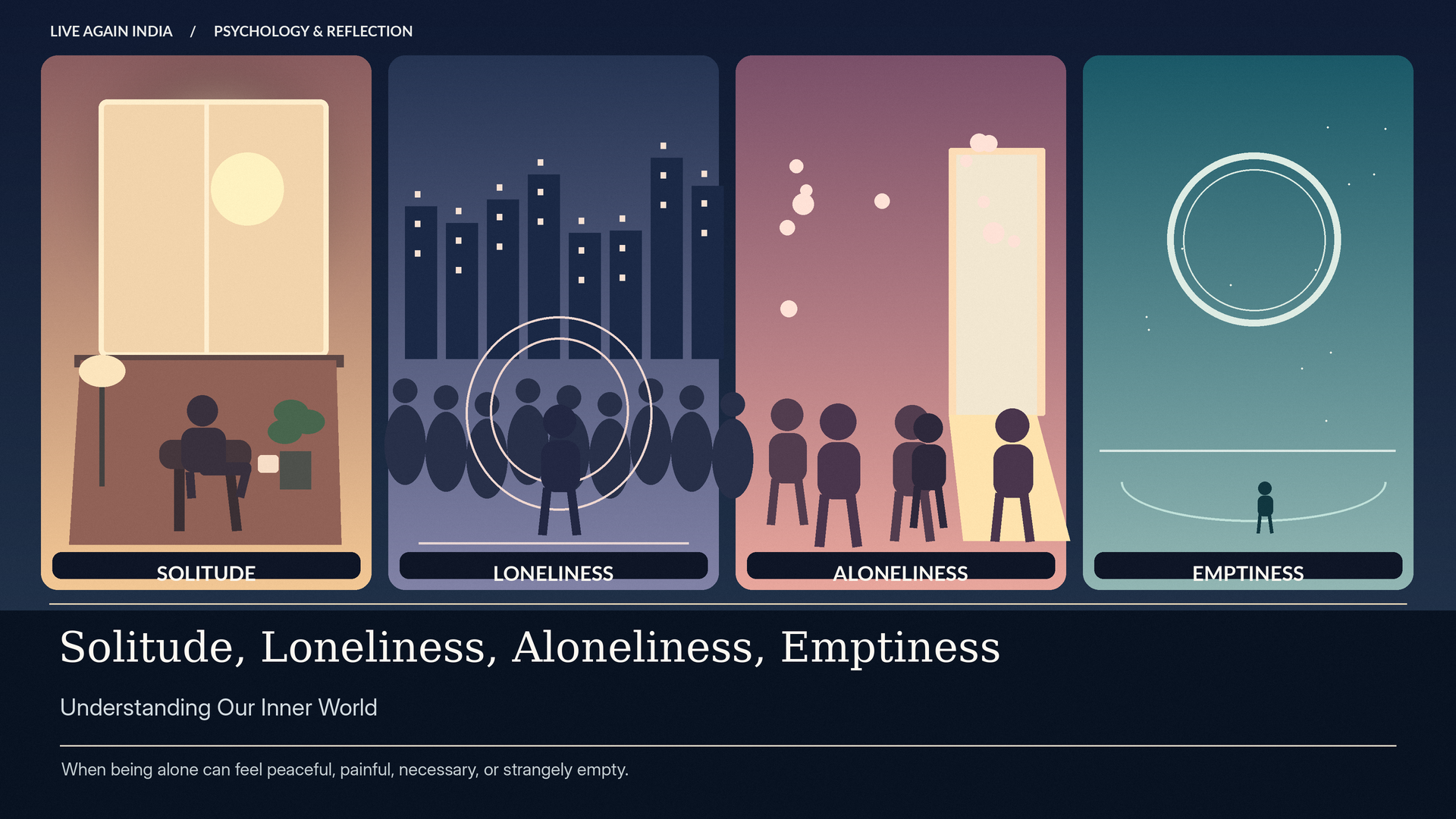
Solitude : Loneliness : Aloneliness : Emptiness: Understanding Our Inner World
Sometimes, after spending an entire day among people, we come home and sit quietly for a while. There has been work, conversation, perhaps even laughter. Still, something inside feels untouched. Someone else may live alone and feel peaceful with a cup of tea. Someone else may love their family deeply but long for an hour in which nobody asks anything of them. And there are days when a person has both company and personal space, yet cannot explain the emptiness within. I have come to believe that these experiences deserve to be understood separately. Before telling someone to meet more people, learn to enjoy their own company, or simply keep busy, I would rather ask what they are actually missing. That is where I want to begin our conversation about Solitude Loneliness Aloneliness Emptiness.
Today’s Reflection From the Therapy Room
One lesson that stays with me from psychotherapy practice is that we cannot understand a person’s inner life simply by looking at their surroundings. A busy home does not guarantee companionship. A quiet room does not necessarily indicate sadness. And a capable person who continues to manage responsibilities may still feel very far away from their own emotions. When someone says, “I want to be alone,” I do not want to rush towards the conclusion that they are withdrawing from life. Equally, when someone says, “I feel alone,” it is not enough to remind them how many people care about them. Solitude, Loneliness, Aloneliness, Emptiness may sound like neighbouring experiences, but each can be asking us to listen to a different need. These are ordinary human situations, not accounts of anyone in therapy.
Aloneness: A Situation, Not a Verdict
Let us first understand aloneness. It simply means being by oneself. Travelling, eating or reading alone are simply instances of aloneness. The circumstance tells us little about their emotional state. They may be comfortable, relieved, bored, frightened, content, or grieving. We sometimes treat someone alone as evidence something is wrong. We may ask, “Why are you sitting alone?” Perhaps they have chosen that moment or simply enjoy the silence. The more useful question is not whether they are alone; it is how they are experiencing being alone.
Solitude: When Our Own Company Feels Enough
Solitude is often the peaceful, chosen side of spending time with ourselves. It is the freedom to sit without performing, answering, explaining, entertaining or proving anything. It might mean prayer, a morning walk, gardening, reading or doing absolutely nothing. I do not think solitude has to look impressive to be valuable. It can be as ordinary as drinking tea without checking the phone.
Research by Nguyen, Ryan and Deci on solitude and emotional regulation found that time alone can lower emotional arousal; when people actively choose solitude, it may also support relaxation and reduced stress. Yet solitude imposed through rejection, illness or circumstance may feel entirely different. Choice matters. A person who is comfortable in their own company need not be rescued from it, and a person who finds silence difficult need not be criticised for that difficulty.
Loneliness: When Being Connected Is Not the Same as Feeling Connected

Loneliness is not measured by the number of contacts saved in our phone or the people sitting around our dining table. It is the pain of missing the connection we need. The World Health Organization’s explanation of social connection describes loneliness as a distressing gap between the connections we have and those we want or need. This is why a person can attend a celebration, speak to everyone, return home and still feel lonely.
I often think the most difficult loneliness is not always the absence of people. Sometimes it is the experience of being unable to share what is genuinely happening inside. We may have people to discuss bills, work, children, meals and responsibilities, yet hesitate to speak about fear, disappointment, longing or a personal struggle. A conversation takes place, but emotional contact does not. They may not need ten more friends, only one relationship where they can speak without defending their feelings. Loneliness deserves understanding, not an instruction to become more social overnight.
Aloneliness: When There Is Not Enough Room to Be With Ourselves
Here is a less familiar word, but one that names an experience many people may recognise. Aloneliness means the discomfort that arises when we do not get as much time alone as we need. In a 2019 paper, Coplan and colleagues introduced and examined aloneliness as dissatisfaction with insufficient solitude. It is a research concept, not a mental-health diagnosis.
Think of someone whose day begins with family demands, continues through meetings and phone calls, and ends with more questions, conversations and obligations. They may love their family and their work, yet have lost the chance to hear their own thoughts. They are not asking to be abandoned. They are asking for a little room to breathe. A request for personal space is not necessarily rejection. Sometimes the most caring thing in a relationship is to allow the other person an uninterrupted hour and trust that closeness can continue afterward.
Emptiness: When Even Company and Quiet Do Not Reach Us
Emptiness is perhaps the hardest of these experiences to describe. Life continues, responsibilities are met, and there may be no single event explaining the discomfort. Yet joy feels distant. Achievements do not settle within. They are present in their daily life without feeling fully present to it. Some people describe numbness; others speak of a loss of direction, interest or personal meaning. It is not necessarily the wish for another person, nor simply the wish to be left alone.
A study of lived experiences of emptiness described a sense of moving through life mechanically, with numbness, purposelessness and disconnection. This deserves seriousness, not an automatic psychiatric label. Emptiness can arise in different circumstances and may overlap with grief, prolonged stress, depression, changes in identity or difficult relationships. If someone says they feel empty, my first response should not be to hand them a label. I would want to understand what has become distant: their emotions, their values, their relationships, their hopes, or their sense of themselves.
Where Solitude Loneliness Aloneliness Emptiness Overlap
These are not four separate boxes into which every person can be neatly placed. Someone may feel lonely after a painful separation and still crave solitude because social conversations feel exhausting. A caregiver may need time alone and also miss being emotionally understood. A person recovering from prolonged stress may experience moments of quiet relief alongside a deeper sense of emptiness. Solitude, Loneliness, Aloneliness, Emptiness can appear together or change from one phase of life to another.
That is why I resist conclusions based only on behaviour. A person who declines an invitation may be protecting precious rest, avoiding an uncomfortable situation, grieving, or feeling disconnected. The behaviour is visible; the reason may not be. We understand someone better when we ask with genuine interest than when we interpret their silence on their behalf.
Relationships Need Closeness, but They Also Need Space
In our families, we sometimes equate love with constant availability. A call must be answered immediately. A quiet evening needs an explanation. Wanting to spend time alone can be heard as, “You no longer care about us.” On the other side, someone who repeatedly asks for companionship may be dismissed as demanding or dependent. Neither response helps us recognise the need underneath.
Healthy relationships need togetherness and individuality. Being available does not mean being available every minute. I would like us to become more comfortable with simple, respectful sentences: “I have missed talking to you”; “I am emotionally tired and need some quiet”; “Can we sit together without discussing problems?” These small acts of honesty can prevent misunderstanding from becoming resentment. Solitude, Loneliness, Aloneliness, Emptiness become easier to discuss when people feel safe enough to describe their needs without being blamed for them.
Before Looking for a Solution, Understand the Need
There is a tendency to respond to emotional discomfort by doing something immediately. We call a friend, scroll through photographs, take on another task, plan an outing or close the door and withdraw. They may help briefly, but the deeper question remains: what do I need right now?
If I am lonely, perhaps I need an honest conversation rather than more social activity. If I am overwhelmed by constant interaction, perhaps I need an agreed period of solitude rather than an argument about boundaries. If I feel empty, I may need time to understand what has lost meaning instead of expecting entertainment to restore it. And if I enjoy my own company, nothing needs correcting. The NHS guidance on loneliness encourages manageable steps, talking about feelings and seeking support when loneliness begins to affect everyday life. The point is to begin with the right question.
When These Experiences Deserve Clinical Attention
Not every difficult evening requires therapy. Sadness, the wish for company, and the need to withdraw briefly are part of being human. But I would pay closer attention when disconnection continues for weeks, relationships are suffering, sleep or daily functioning changes markedly, or the person feels persistently numb, hopeless or unable to take pleasure in life. These experiences may warrant assessment rather than being dismissed as a phase. The US National Institute of Mental Health notes that persistent empty mood, loss of interest and changes in functioning may be among the symptoms of depression, though assessment depends on the broader clinical picture. If distress includes thoughts of self-harm or an inability to stay safe, urgent professional or emergency support is needed.
Finding a Balance That Belongs to You

I do not believe there is a perfect number of hours we should spend alone or with others. A person may need more closeness during grief and more quiet during an overwhelming week. Needs change. Notice which moments restore us, drain us, or leave us feeling unseen. We can protect a little personal space, cultivate one honest relationship, return to an activity that matters, or seek help when these attempts do not reach the deeper problem. Solitude, Loneliness, Aloneliness, Emptiness are not measures of someone’s worth or maturity. They are invitations to understand what our emotional life is asking of us.
For me, the deeper message is simple: being alone is not always loneliness; being surrounded by people is not always connection; and being busy is not the same as feeling fulfilled. Solitude, Loneliness, Aloneliness, Emptiness remind us that the human mind needs more than a crowded calendar or an empty room. It needs a life in which there is space to be ourselves and freedom to reach another person when connection matters. If these words describe something familiar to you, there is no need to force an immediate explanation. Begin by listening to what the feeling is trying to tell you.
How a Therapist Can Help You
In therapy, we can explore whether the difficulty is an absence of meaningful connection, a lack of personal space, or a deeper sense of emotional disconnection. We can understand the patterns, losses, expectations and experiences that may be contributing to it. Together, we can work on boundaries, relationships, emotional awareness and ways of rebuilding meaning without rushing to a diagnosis. The purpose is not to tell you how much company you should keep, but to help you recognise what supports your own wellbeing.
Welcome to Live Again India Mental Wellness
At Live Again India Mental Wellness, we believe that your emotional experiences deserve to be heard with respect, even when you find them difficult to explain. You do not have to pretend to be comfortable when you feel lonely, exhausted by company, or disconnected within yourself. We are here to support you in understanding your experiences and moving towards a more meaningful, emotionally healthier life. Your life is precious, and whatever stage of life you are going through, you are not alone. We are with you.
L@A
By Inderjeet Singh | Live Again India Mental Wellness


