
AI Layoffs Employment Anxiety: Why Indian Men Feel Job Insecure
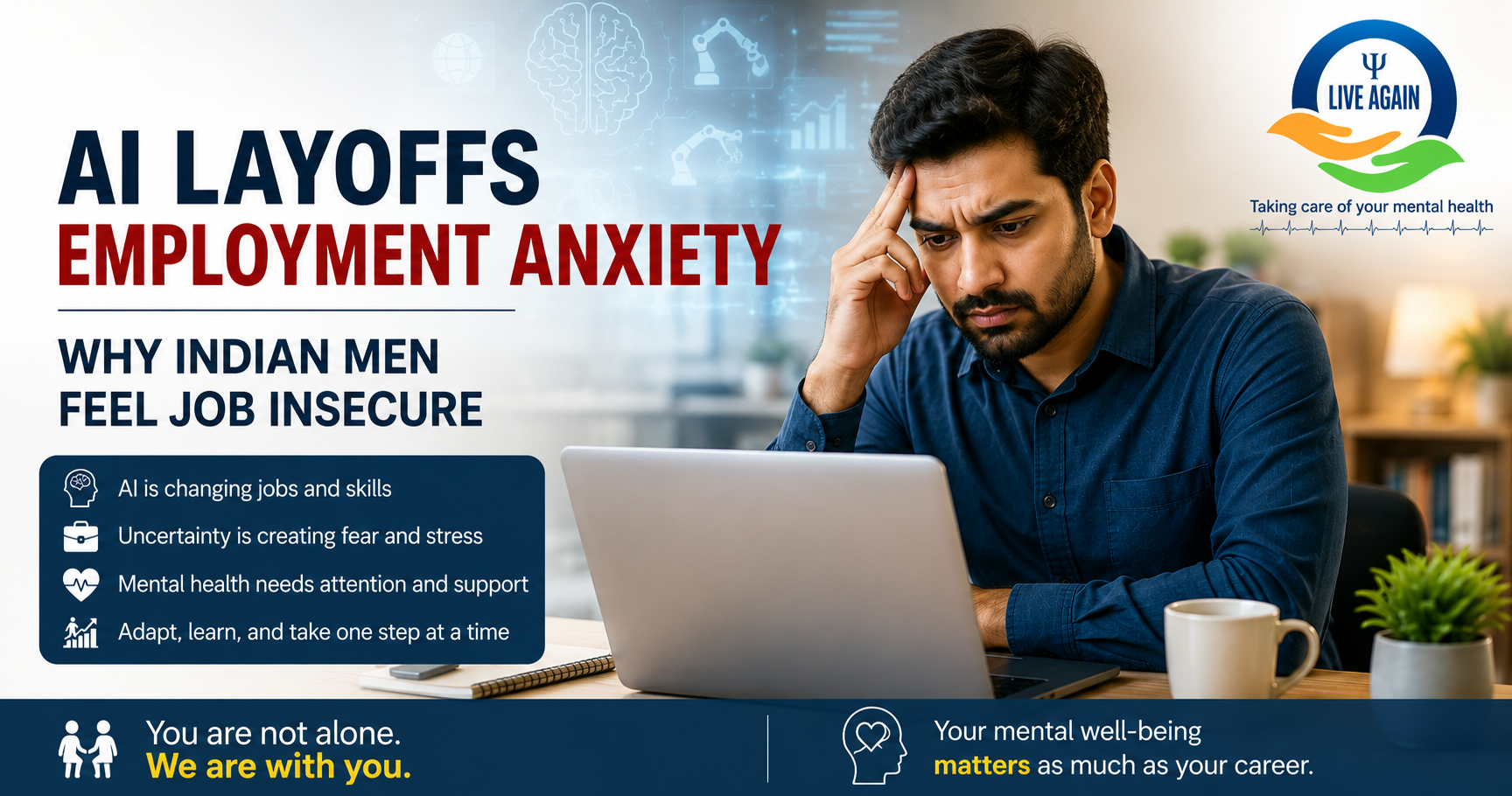
Artificial intelligence is changing how people work, learn, hire, plan careers, and think about the future. For many Indian men, this shift is not only a technological issue. It is also an emotional and mental-health issue. This is why AI Layoffs Employment Anxiety deserves serious attention.
A man may be employed today yet still worry about tomorrow. He may have a salary, family responsibilities, loans, children’s education expenses, ageing parents, and social expectations. Yet inside, he may quietly ask, “Will AI replace my role?” “Will my skills become outdated?” “Will younger people adapt faster?” “Will I be able to protect my family’s future?”
This article continues the Men’s Mental Health India Series by Live Again India Mental Wellness. After discussing men’s silent suffering, depression symptoms, and emotional suppression, this article explores one of the most significant modern pressures affecting Indian men across age groups: employment anxiety in the age of AI.
Understanding AI Layoffs Employment Anxiety

AI Layoffs Employment Anxiety refers to the fear, stress, and uncertainty people experience when artificial intelligence, automation, restructuring, or digital transformation threatens job security, career identity, income stability, and future relevance.
This anxiety is not limited to people who have already lost jobs. It can affect those who are still employed but constantly fear becoming replaceable. It can affect students choosing careers, freshers entering the job market, mid-career professionals trying to stay relevant, and senior workers concerned about adapting to new systems.
For Indian men, this anxiety often carries additional emotional weight. Work is frequently linked with identity, self-respect, marriage, fatherhood, family responsibility, and social standing. As a result, job insecurity does not remain confined to the workplace. It affects sleep, mood, relationships, confidence, and daily life.
Why AI Layoffs Employment Anxiety Matters in India
India has one of the world’s largest working-age populations and a rapidly growing workforce. This makes employment transformation especially important. The ILO India Employment Report 2024 highlights youth employment, education, and skills as critical concerns for India’s future.
In this environment, AI creates not only excitement but also uncertainty. Students wonder whether their degrees will remain relevant. IT professionals worry about coding automation. Content creators worry about AI-generated writing. Designers worry about AI image tools. Customer-support workers worry about chatbots. Corporate employees worry about restructuring.
For many Indian families, one person’s income supports several dependents. Therefore, AI-related job insecurity often becomes more than an individual concern. It becomes a family concern.
AI Is Not the Enemy, but Uncertainty Is Real
This article is not anti-AI. Artificial intelligence can improve productivity and support healthcare, education, agriculture, accessibility, governance, and business efficiency. India is also investing in AI development and skill-building through initiatives such as the IndiaAI Mission.
However, the emotional reality cannot be ignored. Even when AI creates opportunities, it can also change existing roles, reduce repetitive tasks, increase competition, and demand new skills. People may not fear AI itself; they may fear being left behind.
A balanced perspective is essential. AI may not replace every job, but it can transform many tasks. The fear is often not total job loss. It may be fear of skill loss, identity loss, income uncertainty, or declining professional confidence.
What Global Job Reports Tell Us
The World Economic Forum Future of Jobs Report 2025 states that technological change, economic uncertainty, demographic shifts, and the green transition are expected to reshape labour markets by 2030. It estimates that structural labour-market transformation may create 170 million jobs while displacing 92 million jobs globally by 2030.
This suggests that the future of work is not simply about jobs disappearing. Some jobs may decline, some roles may evolve, and entirely new opportunities may emerge. While some people may adapt successfully, others may struggle with the transition.
The report also highlights the growing importance of AI, big data, technological literacy, resilience, flexibility, and lifelong learning. For working men, this creates both opportunity and pressure. The message is clear: adaptability is becoming essential.
Why Indian Men Feel Job Insecure
Many Indian men carry employment pressure on multiple levels. A job is not only a source of income. It may represent dignity, family pride, marriage stability, fatherhood, repayment capacity, and social respect.
When job insecurity increases, the emotional impact can be significant. A man may fear disappointing his parents, worry about his spouse’s expectations, feel ashamed of financial dependence, compare himself with peers, or hide workplace fears from family members to avoid causing concern.
This is where AI Layoffs Employment Anxiety becomes a mental-health issue. The pressure may appear as irritability, overthinking, poor sleep, silence, anger, low mood, physical tension, or an urgent need to learn everything at once.
Different Age Groups, Different Fears
AI-related employment anxiety affects different age groups in different ways.
For students and freshers, the fear is: “Will there be enough jobs when I graduate?”
For early-career professionals, the fear is: “Will my current skills become outdated too quickly?”
For mid-career men, the fear is: “After years of responsibility, can I still change direction?”
For men with families, the fear is: “How will I manage EMIs, children’s education, parents, and household expenses if my job becomes unstable?”
For older professionals, the fear is: “Can I reskill at this stage, or will employers prefer younger workers?”
The issue is therefore not limited to youth. It affects men throughout their working lives, although the emotional meaning changes with age, responsibility, and family circumstances.
Provider Pressure and Self-Worth
In many Indian families, men are still expected to be reliable providers. Even when women contribute equally to household finances, many men continue to carry deep internal pressure around earning and financial protection.
When AI threatens job stability, it can affect self-worth. A man may think, “If I cannot provide, who am I?” This belief can be emotionally damaging because it ties personal value to salary, role, and productivity.
A healthier perspective is needed. A man’s worth is not defined solely by income. Yet it is important to understand why employment anxiety feels so intense. For many men, career instability can feel like identity instability.
Mental-Health Signs of Employment Anxiety
Employment anxiety does not always appear as panic. Often, it develops quietly.
Some men may repeatedly check layoff news. Others may compare themselves with younger professionals, consume endless AI-related content, start multiple courses without completing them, become irritable at home, or avoid conversations about work.
Other signs include poor sleep, headaches, body tension, acidity, difficulty concentrating, low motivation, excessive caffeine use, emotional withdrawal, angry outbursts, alcohol misuse, and constant worry about the future.
The NHS stress guidance notes that stress can affect people physically, mentally, and behaviourally, including concentration, sleep, irritability, physical symptoms, and increased substance use. These signs are highly relevant to employment anxiety.
The Anxiety of Becoming Irrelevant

One of the deepest fears associated with AI-related job anxiety is not job loss itself. It is the fear of becoming irrelevant.
A man may think, “The world is moving faster than me.” “My experience may no longer matter.” “Younger people understand AI better.” “My skills may lose value.” “I may not be able to catch up.”
This fear often creates shame. Instead of seeking help, many men hide their uncertainty. They may appear confident while feeling lost internally. Some avoid learning because learning exposes what they do not yet know.
However, not knowing everything is not failure. Refusing to learn because of fear is the greater risk.
AI Layoffs Employment Anxiety: Panic Upskilling Can Also Harm
Upskilling is important, but panic-driven upskilling can become another source of stress. Some people enrol in multiple AI courses, coding programs, certifications, and productivity workshops simultaneously. Instead of feeling empowered, they become overwhelmed.
A structured learning plan is far more effective. Useful questions include:
What is my current role?
Which tasks in my work are changing?
Which AI tools are relevant to my field?
Which one skill can improve my work in the next 30 days?
Which course is practical, credible, and manageable?
The goal is not to learn everything. The goal is to become steadily more adaptable.
AI Layoffs Employment Anxiety and Relationships
Employment anxiety often affects relationships. A man may become quiet, defensive, irritable, or emotionally distant. His partner may ask what is wrong, and the answer may be, “Nothing,” even when significant worry exists beneath the surface.
Financial concerns can also trigger conflict. EMIs, rent, school fees, parental healthcare, and household expenses may become emotionally charged topics. Men may feel judged even when family members are simply trying to understand.
This can create a cycle. The man feels pressure, withdraws emotionally, family members become concerned, questions increase, and withdrawal deepens. Therapy can help families discuss employment fears without blame, panic, or shame.
AI Fear, Depression and Emotional Suppression
This article also connects with earlier topics in the series. Many men hide job anxiety because emotional suppression has become familiar. Instead of saying, “I am scared,” they may become angry, distracted, overworked, or withdrawn.
When employment fear continues for a prolonged period, it can contribute to low mood, hopelessness, sleep disturbance, reduced confidence, and depression-like symptoms. A man may begin to feel incapable or believe that his future opportunities are shrinking.
This is why AI Layoffs Employment Anxiety should not be dismissed as simple overthinking. Left unaddressed, it can become a significant emotional burden.
AI Layoffs Employment Anxiety: What Can We Do Practically
The first step is to acknowledge the fear honestly. Saying, “I am anxious about my career,” is healthier than pretending everything is fine.
The second step is to separate realistic concerns from imagined catastrophes. Not every AI headline applies to every profession. Individuals should evaluate their own role, industry, skills, and learning needs.
The third step is to create a simple development plan. One useful course, one AI tool, one updated résumé, one professional conversation, and one weekly learning session may be enough to begin.
The fourth step is to protect physical and mental health. Sleep, exercise, routine, nutrition, and emotional support matter. A tired mind struggles to plan effectively.
The fifth step is to talk to someone. Silence amplifies fear. Speaking with a therapist, mentor, spouse, trusted friend, or career advisor can reduce confusion and restore perspective.
How Families Can Support Men
Families should avoid mocking or minimizing employment anxiety. Statements such as “Why are you worried?” or “Just learn AI” may increase shame rather than reduce it.
A more supportive response is: “This change is difficult. Let us think about it calmly.” Families can help by reducing panic, discussing finances realistically, supporting skill development, and avoiding repeated criticism.
Support does not mean ignoring reality. It means facing reality together without emotional attacks. Men often open up more easily when they feel respected rather than judged.
Families can also help by planning expenses carefully, reducing unnecessary pressure, and appreciating effort during periods of transition.
Therapy Can Help: AI Layoffs Employment Anxiety
Therapy can help individuals to manage employment anxiety with greater emotional clarity and practical planning. It can address fear, shame, anger, avoidance, overthinking, comparison, and catastrophic thinking.
Therapeutic support may include cognitive restructuring, stress management, emotional regulation, behavioural planning, family communication, sleep improvement, and confidence rebuilding. In some cases, career counselling or psychiatric support may also be beneficial.
The NHS guidance on generalised anxiety disorder explains that anxiety can involve excessive worry, difficulty controlling thoughts, sleep problems, irritability, fatigue, and concentration difficulties. These symptoms often appear when employment uncertainty becomes chronic.
Therapy does not remove AI from the world. It helps people face a changing world with greater calm, resilience, and preparation.
How a Therapist Can Help You
A therapist can help you understand how AI-related job insecurity affects anxiety, sleep, mood, anger, confidence, and relationships. Therapy can reduce catastrophic thinking, improve emotional regulation, and support realistic planning. It can also help individuals manage provider pressure, family stress, shame, and fears of becoming irrelevant. With the right support, AI Layoffs Employment Anxiety can shift from panic and helplessness toward awareness, preparation, and healthy adaptation.
Welcome to Live Again
Welcome to Live Again. Live Again India Mental Wellness supports emotional wellbeing with care, respect, and psychological understanding. If AI-related job insecurity, skill pressure, career fear, or family responsibility is affecting your mental health, please remember that you are not alone. Your life is precious, and with timely support, calm planning, emotional regulation, and practical action, stability and confidence can return.
Previous article in this series: Emotional Suppression In Men
Today’s Reflection From The Therapy Room
Many people are not afraid of work itself. They are afraid of becoming unable to protect the life they are responsible for.
AI may change jobs, skills, hiring practices, and industries. But fear does not have to become panic. The future requires preparation, not emotional collapse.
A man does not become weak because he feels anxious about employment. He becomes stronger when he acknowledges the fear, understands the change, learns steadily, and seeks support when needed.
The age of AI requires skills, but it also requires emotional stability. A calm mind learns better than a panicked one.
L@A