Anxiety Symptoms And Treatment: Healing is a process
Anxiety Symptoms And Treatment matter because anxiety often enters life quietly, not dramatically. A person may keep smiling, working, caring for family, and doing everything that needs to be done, while inside feeling tired, tense, unsafe, or unable to rest. The mind stays busy, the body stays alert, and even simple moments begin to feel heavy. If you have been living like this, you are not weak, and you are not alone.
Sometimes anxiety begins in the mind. A person may think, “What if something goes wrong?” or “What if I lose control?” At other times, the body reacts first. Sweating, dizziness, trembling, a racing heartbeat, chest tightness, tingling, stomach discomfort, or muscle tension may appear before the person even realises that anxiety is active.
The World Health Organization, the National Institute of Mental Health, and the NHS all describe anxiety as a condition that can affect thoughts, emotions, physical sensations, behaviour, and daily functioning.
This article explains the common signs of anxiety, why the body reacts so strongly, what treatment may involve, when self-help can help, and when professional support becomes important.
Understanding Anxiety Symptoms And Treatment
Anxiety is a natural response to threat, uncertainty, pressure, or danger. In small amounts, it can help a person prepare, pay attention, or act carefully. A student may feel alert before an examination. A parent may become more attentive when a child is unwell. A professional may prepare more carefully before an important meeting.
The problem begins when anxiety becomes persistent, excessive, hard to control, or out of proportion to the actual situation. Then the mind keeps searching for certainty, and the body stays on alert even when no immediate danger exists.
Anxiety is not only fear. It can also look like constant mental activity, irritability, repeated future thinking, inability to relax, fear of mistakes, excessive planning, or avoidance. Because of this, many people do not identify it quickly. They simply say, “I think too much,” “I feel uneasy,” or “my body never relaxes.”
Anxiety Symptoms And Emotional Signs
The emotional and cognitive signs of anxiety may include excessive worry, nervousness without a clear reason, poor concentration, fear that something bad may happen, low frustration tolerance, and difficulty tolerating uncertainty.
Many people replay the same situation again and again. Some seek repeated reassurance from family, doctors, friends, or the internet. Others stay silent because they do not want to burden anyone. The NIMH guidance on generalized anxiety disorder describes excessive worry, restlessness, irritability, concentration problems, and sleep disturbance as common features. Readers who struggle mainly with repeated mental loops may also find How To Stop Overthinking useful.
Anxiety Symptoms And Physical Signs
Anxiety often affects the body strongly. Common physical signs include sweating, dizziness, trembling, a fast heartbeat, chest discomfort, breathlessness, nausea, stomach upset, tingling, headaches, muscle tension, hot flushes, fatigue, restlessness, and disturbed sleep.
The NHS guidance on anxiety, fear, and panic lists experiences such as light-headedness, chest discomfort, sweating, breathlessness, feeling hot, and shaking. These symptoms are real. When anxiety contributes to them, the person is not imagining them.
Still, new, severe, persistent, or medically unclear symptoms need proper medical evaluation. Physical illness, medication effects, dehydration, sleep deprivation, hormonal changes, and substance use can produce overlapping signs.
Why Anxiety Affects the Body
When the brain detects threat, the body prepares to protect itself. Heart rate may rise. Breathing may change. Muscles may tighten. Attention may narrow. This response helps during a real emergency.
However, anxious thoughts, unresolved stress, relationship conflict, and ongoing uncertainty can keep sending danger signals. Then the nervous system stays activated for too long. Even a small bodily sensation may start to feel alarming. Fear grows, the body reacts more strongly, and the cycle feeds itself.
The World Health Organization’s guidance on stress notes that stress can affect people physically, mentally, and behaviourally. Therefore, recovery usually needs sleep, movement, routine, emotional expression, and repeated experiences of safety.
Anxiety Symptoms And Daily Life
Anxiety often connects with academic pressure, career uncertainty, job insecurity, marriage expectations, financial responsibility, family conflict, caregiving burden, health worry, and social comparison.
A student may fear that one examination will decide the whole future. A professional may compare salary and career progress with peers. A parent may stay preoccupied with a child’s education or employment. A caregiver may feel guilty for being tired. Likewise, a person in a relationship may keep checking for signs of rejection, distance, or emotional withdrawal.
These concerns may grow from real pressures. Therefore, treatment cannot rely only on “think positive” advice. Instead, a person often needs help separating practical problems from imagined catastrophe, acting on what can be changed, and reducing the emotional cost of uncertainty.
Panic and Health Anxiety
Some people experience anxiety gradually through constant tension and worry. Others have sudden episodes of intense fear. Panic-like experiences may include a pounding heartbeat, sweating, trembling, breathlessness, dizziness, chest discomfort, tingling, nausea, feeling unreal, or fear of collapsing or losing control.
The NIMH information on panic disorder describes symptoms such as racing heart, sweating, trembling, breathing difficulty, dizziness, tingling, chest pain, and stomach distress. Because some of these symptoms overlap with medical emergencies, first-time or severe episodes may require urgent medical assessment.
Health anxiety may involve repeated body-checking, frequent symptom-searching, repeated tests, or ongoing doubt even after normal results. The problem is not that health should be ignored. The problem is that repeated checking trains the brain to treat every sensation as dangerous. As a result, reassurance may calm the person briefly while keeping the anxiety cycle active.
Relationships, Work, and Sleep
Anxiety often affects close relationships. A person may seek repeated reassurance, overanalyse tone and behaviour, fear abandonment, avoid difficult conversations, or become more reactive. Some people withdraw because they fear conflict. Others repeatedly question or demand certainty because they feel unsafe.
When anxiety goes unrecognised, both partners may misread the situation. One person feels afraid and overwhelmed. The other feels mistrusted or pressured. Because of this, treatment may include work on communication, boundaries, reassurance cycles, and emotional regulation. Readers whose distress is strongly linked with family conflict may also find Toxic Communication In Families relevant.
At work or during study, anxiety may reduce concentration, increase perfectionism, delay decisions, and make ordinary choices feel risky. Poor sleep then increases irritability and bodily sensitivity, which strengthens the cycle again.
Anxiety Symptoms And Treatment: Professional Assessment
No two people experience anxiety in exactly the same way. One person may worry mainly about health, while another worries about relationships, money, examinations, work, or social evaluation. Some people have panic attacks. Others stay tense for long periods without sudden episodes.
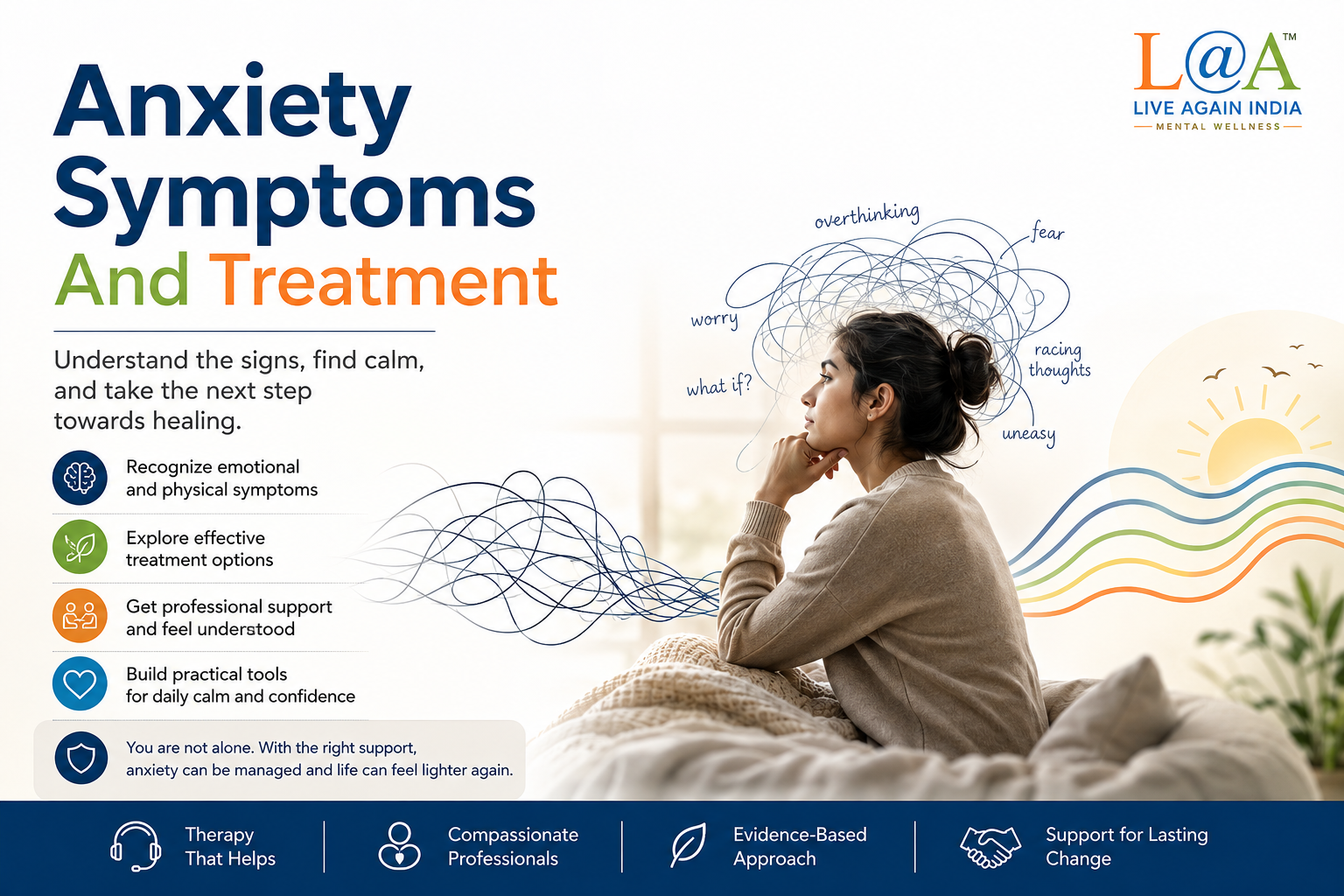
Professional assessment usually includes a detailed clinical interview. The clinician may explore onset, triggers, bodily symptoms, sleep, avoidance, medical factors, substance use, relationships, and current safety. Screening tools may support the process, but they do not replace clinical judgement. The main aim is to understand what maintains the anxiety and what support is most appropriate.
Anxiety Symptoms And Treatment: Therapy, Self-Help, and Medication
Anxiety Symptoms And Treatment work best when care addresses thoughts, emotions, behaviour, body regulation, and daily routine together.
Anxiety Symptoms And Treatment Through Psychoeducation
Many people feel less frightened once they understand how the anxiety cycle works. Learning that dizziness, sweating, trembling, and racing thoughts may come from an activated nervous system often reduces secondary panic.
Anxiety Symptoms And Treatment Through Psychotherapy
Psychological treatment is one of the most important evidence-based interventions for anxiety. The WHO anxiety fact sheet identifies psychological interventions as essential treatments. The American Psychological Association also explains how cognitive behavioural therapy helps people work with unhelpful thinking and behaviour patterns. Therapy may help a person recognise triggers, question catastrophic predictions, reduce avoidance, improve emotional regulation, and tolerate uncertainty better.
Anxiety Symptoms And Treatment Through Gradual Exposure
When avoidance keeps fear active, therapy may involve gradually approaching feared situations in a planned and safe way. Exposure does not mean forcing someone into overwhelming distress. Instead, it helps the nervous system learn that anxiety can rise and fall without escape.
Anxiety Symptoms And Treatment Through Relaxation and Grounding
Slow breathing, grounding, progressive muscle relaxation, mindfulness, and guided relaxation may reduce bodily activation. These methods work best through repetition rather than occasional use during crisis.
Anxiety Symptoms And Treatment With Medication When Needed
Medication is not required in every case. Some people improve through psychotherapy, routine correction, and behavioural change. Others may benefit from psychiatric medication when anxiety is moderate to severe, panic is frequent, sleep is significantly impaired, or daily functioning has reduced. A qualified medical professional should make medication decisions.
Anxiety Symptoms And Treatment: Self-Help That Can Actually Help
Self-help works best when it is practical and repeatable. Helpful steps include writing worries down, setting a limited worry period, walking regularly, reducing caffeine when it worsens symptoms, eating on time, maintaining regular sleep, and reducing repeated symptom-searching.
Ask yourself, “Is there something practical I can do about this today?” If yes, act. If not, postpone rumination and return attention to the present. The NHS Every Mind Matters guidance on tackling worries recommends writing worries down, separating practical worries from hypothetical ones, and using a limited worry period. Readers who relate more strongly to repeated mental loops may also find How To Stop Overthinking useful.
Anxiety Symptoms And Treatment: What Often Makes It Worse
Several patterns unintentionally make anxiety worse. These include constant symptom-checking, avoiding every uncomfortable situation, using alcohol or nicotine to calm down, sleeping irregularly, making major decisions while highly anxious, and expecting immediate certainty.
Avoidance gives short-term relief, but it also teaches the brain that escape was necessary. Repeated reassurance may calm a person briefly, yet it can gradually reduce confidence in handling uncertainty. Therefore, the goal is not to eliminate every anxious thought. The goal is to reduce the behaviours that keep confirming that anxiety is dangerous and unmanageable.
Choosing Anxiety Symptoms And Treatment Support
When seeking clinical psychological support in India, it is reasonable to ask about the professional’s training, scope of practice, and relevant registration. The Rehabilitation Council of India maintains the Central Rehabilitation Register for qualified rehabilitation professionals.
Psychiatrists are medical doctors who can prescribe medication. Psychologists and psychotherapists work within their training and professional scope. Good care should feel respectful, confidential, and clear about treatment goals.
When To Seek Help
Professional support becomes important when anxiety continues for several weeks or longer, physical symptoms keep returning, sleep is significantly disturbed, work or study performance is dropping, ordinary situations are being avoided, relationships are affected, panic episodes occur, self-help is not enough, or low mood and hopelessness are increasing.
Seeking help does not mean failure. It means structured assessment and treatment may now be useful. Earlier support often protects functioning and prevents a smaller pattern from becoming more deeply established.
Urgent Support
Seek urgent help if anxiety comes with suicidal thinking, self-harm risk, severe hopelessness, inability to stay safe, major behavioural disorganisation, or a medical emergency.
In India, Tele-MANAS support is available through 14416 or 1800-89-14416 under the National Mental Health Programme. For an immediate safety emergency, contact 112 or go to the nearest hospital. You can also connect to Tulasi Healthcare for mental health assistance and rehabilitation treatment. For support through Live Again India Mental Wellness, you can contact 9971207507.
Frequently Asked Questions
Can anxiety happen without a clear reason?
Yes. Anxiety may begin around an obvious stressor, yet sometimes the person notices symptoms before identifying the emotional or situational trigger. The nervous system may also remain sensitised after the original stress has reduced.
Can anxiety cause dizziness and sweating?
Yes. Anxiety may be associated with dizziness, sweating, trembling, a racing heartbeat, and restlessness. At the same time, new or severe physical symptoms still need proper medical assessment.
Is anxiety the same as weakness?
No. Anxiety is not a character weakness. It is a psychological and physiological response pattern that can become intense, prolonged, and distressing. It can affect high-functioning, responsible, and intelligent people as well.
Can anxiety improve with therapy?
Yes. Many people benefit significantly from therapy, especially when treatment addresses thoughts, body reactions, avoidance patterns, routine, and emotional triggers together.
Does everyone with anxiety need medicine?
No. Some people improve with psychotherapy, behavioural change, sleep correction, and stress management. Others may need psychiatric medication, especially if symptoms are severe, persistent, or highly impairing.
Understanding
Understanding Anxiety Symptoms And Treatment can reduce unnecessary fear and confusion. Anxiety may affect thoughts, emotions, the body, sleep, confidence, routine, work, and relationships. Yet it is treatable. Recovery usually develops through understanding, consistent treatment, healthier routine, reduced avoidance, emotional regulation, and professional guidance when needed.
A person does not need to wait until anxiety becomes extreme before seeking help. Earlier support may prevent deeper exhaustion, stronger avoidance, and more serious disruption. The aim is not to create a life with no uncertainty. The aim is to build the capacity to face uncertainty without being controlled by fear.
Reflection From The Therapy Room
Many people first come to therapy saying that they feel weak, confused, or physically unwell. As the conversation deepens, it becomes clear that they are not simply “overreacting.” Often they have been carrying fear, pressure, emotional suppression, caregiving burden, health worry, or relationship strain for a long time.
In many cases, anxiety is not only about one event. Instead, the nervous system has stayed over-alert for too long. Once that pattern becomes clearer, the person usually feels less frightened by the symptoms and more ready to work on recovery. Change often begins when the question shifts from “What is wrong with me?” to “What has my mind and body been trying to manage?”
How A Therapist Can Help You
A therapist can help you understand what triggers your anxiety, why your body reacts so strongly, and which thoughts and behaviours keep the cycle active. Therapy can support emotional regulation, panic reduction, better sleep, greater tolerance of uncertainty, healthier routine, and more confident coping. With consistent guidance, anxiety can become something you understand and manage rather than something that continues controlling your life.
Welcome To Live Again
Welcome to Live Again. Your life is precious, and you do not have to carry anxiety alone. Live Again India Mental Wellness is supporting you with professional care, dignity, and compassion—you are not alone. If worry, panic, restlessness, sleep disturbance, body symptoms, or emotional strain are affecting your daily life, you may seek professional support and take the next step towards steadiness, clarity, and recovery.