What Is Emotional Fog: Understanding Mental Haze and Emotional Disconnection
There are phases in life when a person is not exactly crying, not exactly panicking, and not exactly falling apart—yet something still does not feel right inside. The mind feels slower. Emotions feel distant. Even simple decisions feel heavier than they should. A person may move through the day, respond to others, complete a few tasks, and still feel as if they are living behind a thin layer of mist. This is the kind of state many people experience but rarely name clearly. One useful way to understand that experience is through the idea of emotional fog.
When people first notice this state, they often become confused. They may ask themselves whether they are becoming lazy, losing interest in life, becoming depressed, or simply failing to try hard enough. But emotional fog is usually not best understood as weakness or lack of character. More often, it is a sign that the mind and nervous system have been carrying more than they can process smoothly. In that state, inner clarity reduces, emotional access becomes weaker, and life begins to feel mentally hazy.
What is emotional fog?
Emotional fog is a state in which a person remains awake, functional, and emotionally affected—but no longer emotionally clear. The person is not always fully numb, and not always intensely overwhelmed either. Instead, they may feel mentally dull, emotionally flat, disconnected from themselves, confused about what they feel, or unable to access their inner clarity in the usual way.
A person in emotional fog may say things like:
- “I don’t feel normal, but I can’t explain why.”
- “I am doing things, but I don’t feel fully present.”
- “My mind feels cloudy.”
- “I know something is heavy inside, but I cannot name it properly.”
This is why emotional fog can be so unsettling. Clear sadness can be recognized. Clear anxiety can be recognized. Even anger is easier to understand when it is direct. But emotional fog feels blurred. The emotional world is present, yet not fully accessible. When emotional fog stays for days or weeks, people often start doubting themselves more than understanding what their mind is trying to signal.
Emotional fog is not exactly depression, anxiety, or burnout
One reason emotional fog is difficult to understand is that it overlaps with several other states without being identical to them. It can appear alongside depression, anxiety, burnout, grief, emotional overload, or chronic stress. But it has its own quality.
In depression, a person may clearly feel low, hopeless, slowed, and heavy. In anxiety, a person often feels activated, fearful, restless, and mentally over-engaged. In burnout, exhaustion and reduced capacity become more obvious. Emotional fog, however, may feel quieter and less dramatic. The person may not be fully collapsed, yet they are not fully alive inside either.
That is why emotional fog is often described as a kind of emotional haze. The problem is not always intensity. Sometimes the problem is reduced clarity, reduced access, and reduced inner connection.
Why emotional fog happens in daily life
Emotional fog usually does not appear out of nowhere. It tends to build gradually when the system has been under strain for too long. The mind and body begin to protect themselves not by becoming sharper, but by becoming less open, less fluid, and less emotionally exposed.
This can happen for several reasons.
Chronic stress
When stress continues for too long, the mind cannot remain fully open and emotionally responsive in the same way. It starts protecting itself. Sometimes this protection looks like overthinking. Sometimes it looks like irritability. Sometimes it looks like tiredness. And sometimes it looks like emotional fog. The American Psychological Association explains that ongoing stress can affect both mind and body in wide-ranging ways, including concentration, energy, and emotional functioning.
A person may still continue daily responsibilities, but the inner experience becomes less vivid. Their emotional system begins to reduce intensity because it has been overloaded for too long.
Unprocessed emotions
Emotional fog often appears when a person has carried many emotions without properly processing them. Hurt, disappointment, pressure, shame, loneliness, frustration, and silent grief may stay inside without finding enough expression. Over time, the system becomes crowded.
When too much remains unfinished inside, the person may stop feeling one clear emotion and instead enter a fog-like state where everything becomes mixed, muted, or distant.
Cognitive overload
Too much thinking can also reduce emotional clarity. When a person keeps analyzing, predicting, reviewing, comparing, and mentally tracking everything, the mind may become full but not clear. Information keeps entering, but inner digestion does not happen properly.
In that condition, the person may know many thoughts but feel cut off from emotional understanding. They become mentally noisy and emotionally blurred at the same time.
Sleep disturbance and physical depletion
Poor sleep does not only affect energy. It affects emotional processing, concentration, tolerance, and inner coherence. A person who is sleeping badly may feel mentally slower, less emotionally organized, and more disconnected from themselves. The NHS guide on stress also notes that stress can affect sleep, concentration, irritability, and daily functioning in exactly these kinds of ways.
Similarly, inactivity, poor appetite, erratic routine, excessive screen exposure, and lack of movement can all contribute to a fog-like internal state.
Interpersonal ambiguity and unresolved relational strain
Sometimes emotional fog appears when a person is living inside unclear emotional situations. A relationship may not be openly broken, but not emotionally safe either. Family tension may remain present without proper closure. A person may keep functioning outwardly while inwardly carrying doubt, confusion, or unspoken pain.
Such states do not always create direct drama. Sometimes they create quiet fog.
What emotional fog feels like from the inside
The inner experience of emotional fog can vary from person to person, but some patterns are common.
A person may feel mentally slower than usual. Thoughts may not stop completely, but they may feel less sharp and less organized. Decision-making becomes difficult, not always because the decisions are complicated, but because the mind feels less clear.
Emotionally, the person may feel flat, distant, or muted. They may still care about people, but not feel connected in the same way. They may still perform daily tasks, but without the sense of emotional presence that was once natural. Sometimes they feel like they are watching life rather than living it.
This can create internal statements such as:
- “I don’t feel like myself.”
- “I care, but I feel far away from everything.”
- “I am not empty, but I don’t feel fully connected.”
- “My heart is not absent, but it feels covered.”
That last feeling is often very close to the experience of emotional fog.
Signs and symptoms of emotional fog
Some common signs include:
- poor concentration
- reduced mental clarity
- emotional flatness or numbness
- confusion about what one feels
- low motivation without full hopelessness
- indecisiveness
- mental fatigue
- disconnection from self or others
- low inner enthusiasm
- feeling stuck or internally slowed
A person may still attend work, speak to family, or complete responsibilities, but something inside feels less alive and less accessible.
Why emotional fog is often misunderstood
One of the biggest problems with emotional fog is that it is easy to misinterpret. Others may think the person has become lazy, indifferent, cold, or careless. The person themselves may begin to fear that they are losing intelligence, losing personality, or becoming emotionally damaged.
But very often, emotional fog is not a sign of brokenness. It is a sign of overload plus protective withdrawal.
In simple terms, the system may be saying:
“Too much has been happening inside. I cannot stay fully open right now.”
That is why emotional fog should not immediately be judged as a character flaw. It should first be understood as a state that deserves attention.
The nervous system view: emotional fog as a protective response
From a psychological and nervous-system perspective, emotional fog can be understood as a form of protective regulation. When the system cannot comfortably remain in full emotional contact because stress, stimulation, or pain is too high, it may shift into a quieter, lower-access mode.
This does not always look like panic or collapse. Sometimes it looks like a soft internal shutdown. The person is still functioning, but with reduced emotional openness and reduced processing clarity.
This helps explain why emotional fog can feel strange. The person is not fully gone. They are not fully disconnected from reality. But they are not fully connected to themselves either.
The hidden impact of emotional fog
Emotional fog affects more than mood. It can quietly disrupt many areas of life.
Work and productivity
A person may struggle to focus, delay tasks, or feel mentally scattered. Even when they sit to work, the mind may not feel fully available. They may keep switching between tasks, feel mentally tired too quickly, or find it hard to complete even simple things.
Relationships
Emotional fog can make a person seem distant even when they still care deeply. They may not have the emotional energy to express warmth naturally. Conversations may feel flatter. Reassurance may feel harder to give. Emotional closeness may reduce, not because love has gone, but because emotional access has become weaker.
Self-image
Perhaps one of the most painful impacts is internal self-doubt. The person may begin asking:
- “What happened to me?”
- “Why do I feel dull?”
- “Why can’t I feel life the same way?”
- “Am I becoming incapable?”
If emotional fog continues without understanding, self-criticism often increases.
How to move through emotional fog
Clarity usually does not return by force. Emotional fog does not respond well to pressure. Telling yourself to “snap out of it” usually increases inner stress rather than healing.
What helps more is gradual re-engagement.
I. Name the state
Naming reduces confusion. When a person can say, “I think I am in emotional fog,” the experience becomes less shapeless. Awareness itself is therapeutic.
II. Reduce unnecessary input
Too much screen use, social media, fast content, repeated comparison, and constant stimulation make the fog heavier. Reduce non-essential input for some time. Less noise often creates space for clarity to return.
III. Return to the body
Gentle physical grounding helps. Walking, stretching, slowing the breath, washing the face, sitting with both feet on the ground, or using a calming body-based exercise can slowly reduce internal haze.
IV. Allow some emotional expression
Fog often becomes thicker when the person remains silent with everything. Writing, speaking, reflecting, or quietly naming what feels unfinished can begin reopening emotional contact.
V. Restore simple structure
A weak routine worsens emotional fog. The person does not need an extreme plan. They need small structure. The National Institute of Mental Health also emphasizes practical coping steps such as maintaining healthy routines, reducing overwhelm, and using supportive strategies when stress starts affecting mental clarity:
- waking with some rhythm
- reducing lying down for long periods
- moving the body
- eating more regularly
- having at least one daily purpose
These are not superficial lifestyle suggestions. They support mental reorganization.
What not to do during emotional fog
Certain habits make the state worse:
- over-analyzing every feeling
- forcing big life decisions in a foggy state
- judging yourself harshly
- isolating too deeply
- consuming too much stimulating digital content
- expecting instant emotional clarity
Emotional fog usually clears through consistency, safety, and reduced overload—not through panic-driven urgency.
How a therapist can help you
A therapist can help you understand whether emotional fog is coming from stress, sleep disturbance, emotional suppression, anxiety, depression, unresolved pain, nervous-system overload, or a combination of these. Therapy can also help you slowly reconnect with your emotional world without forcing intensity too quickly. The aim is not simply to remove the fog from the outside. The aim is to understand why it formed, what it is protecting, and how the mind can begin to feel safe enough to become clear again.
Welcome to Live Again
Welcome to Live Again. Live Again India Mental Wellness is supporting you—you are not alone. If life has been feeling mentally blurred, emotionally distant, or quietly heavy, it does not mean you are failing. Sometimes the mind reduces clarity because it has been carrying too much for too long. With the right support, gentle structure, and emotional understanding, that fog can slowly begin to lift.
Today’s Reflection From The Therapy Room
Not every difficult phase looks dramatic. Some phases arrive softly. You keep functioning, keep responding, keep moving through the day—and still feel far away from yourself. Emotional fog is often like that. It is not always a collapse. Sometimes it is the mind’s quiet way of asking for less overload, more safety, and a slower return to inner clarity. When that need is respected instead of judged, the fog often begins to lift more gently.
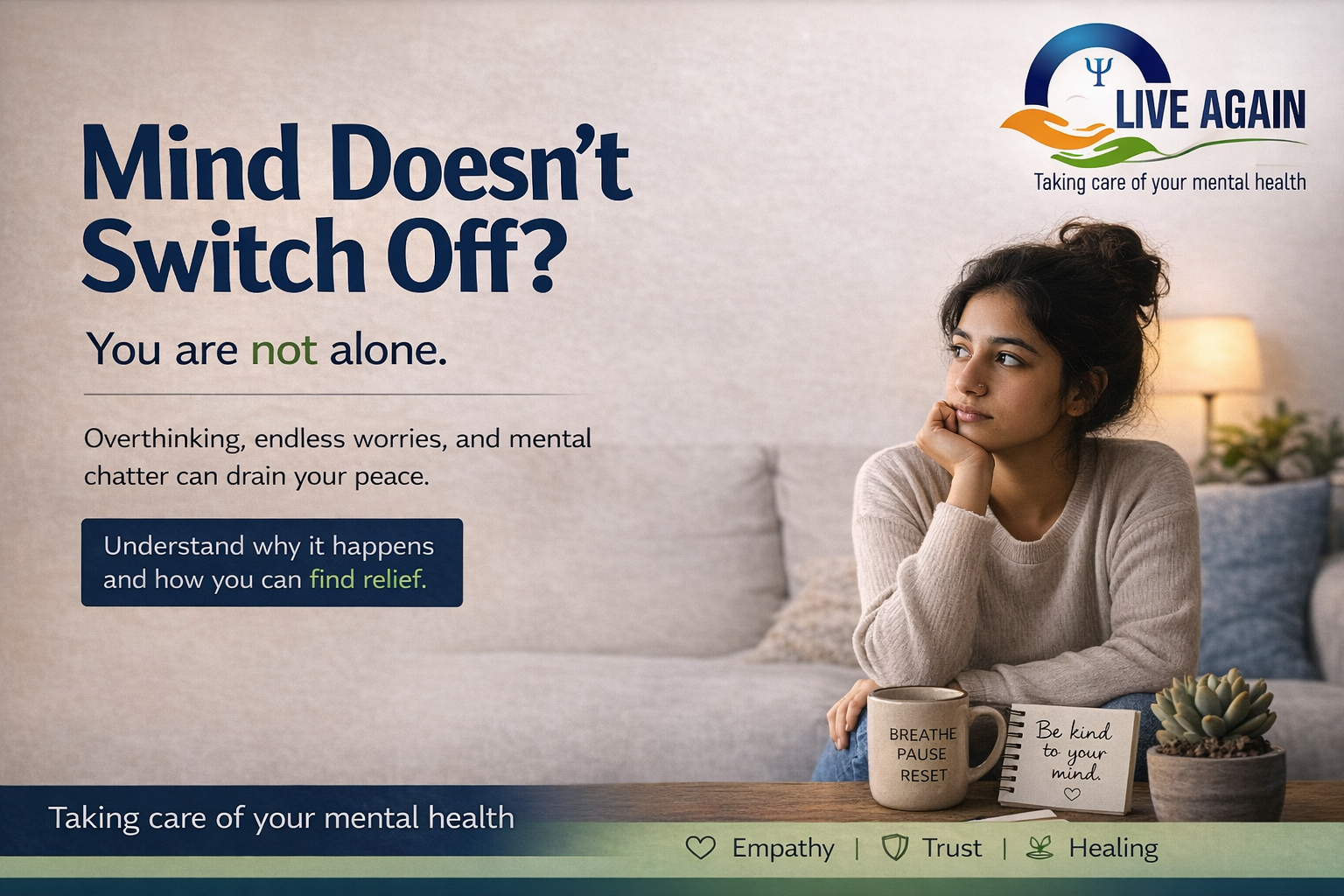
For readers who also struggle with mental overactivity, you may also find this helpful: Mind Doesn’t Switch Off.
L@A