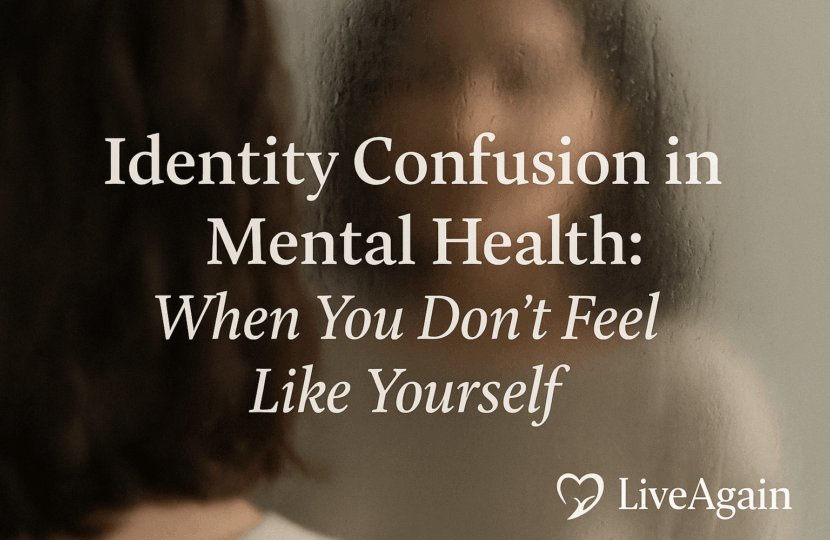
Identity Confusion in Mental Health: When You Don’t Feel Like Yourself. Have you ever looked into your own eyes and felt like someone else was staring back – like a character you’ve been forced to play? Or found yourself saying things that shocked even you, like you were on autopilot? Identity confusion and mental health is more than just losing track of who you are – it’s a haunting sense that your core self has gone missing. You shift through roles, emotions, and expectations, unsure which ones are real. It can feel like drifting between personas, each one shaped by survival, not authenticity. This isn’t mild disorientation – it’s emotional vertigo. A chronic ache of not belonging to your own reflection. And beneath it, a quiet question lingers: “Where did I go?”
Understanding Identity Confusion in Mental Health
Identity confusion in mental health refers to a deep internal disconnection, where a person loses clarity about who they are at their core. This experience often arises during times of stress, major life transitions, or in the aftermath of trauma. It is commonly associated with psychological conditions such as Borderline Personality Disorder (BPD), Complex PTSD, or persistent anxiety disorders. In these states, individuals may feel emotionally fragmented, unsure of their values, or as if they’re wearing different masks to survive – losing touch with a stable, consistent sense of self.
The American Psychiatric Association notes that identity disturbance is one of the diagnostic markers in BPD, where individuals face a persistently unstable self-image and chronic feelings of emptiness (APA).
How Trauma and Emotional Neglect Shape the Self
In early life, our identity is shaped through emotional attunement, validation, and relational safety provided by caregivers. These early interactions lay the foundation for how we understand ourselves and our place in the world. When children experience emotional neglect, abuse, or inconsistent caregiving, they are often forced to abandon their natural impulses in order to gain approval or avoid punishment. In doing so, they begin adopting survival roles – such as the achiever, the caretaker, or the rebel – that help them feel temporarily safe but disconnect them from their authentic self. Over time, this adaptation becomes their default personality, leading to deep identity confusion and emotional fragmentation.
As per the NHS Overview, childhood trauma significantly increases the risk of developing BPD and other disorders associated with identity disturbance.
Signs You’re Struggling with Identity Confusion in Mental Health
- You feel like a different person in different situations, adjusting your tone, behavior, and even emotions depending on who you’re with. At times, you might find yourself adopting others’ opinions or preferences just to belong. This chameleon-like behavior may leave you feeling emotionally hollow or fragmented. You start questioning which version of you is the ‘real’ one. Over time, this constant shifting can result in a profound loss of personal identity.
- Your emotions seem disconnected from your actions, as if you’re performing roles without genuinely feeling what you’re expressing. You may smile during conversations while feeling sadness underneath, or express anger when you’re actually scared. This disconnect can create inner confusion and deepen your sense of alienation. Over time, this misalignment may make it difficult to trust your own reactions. It’s like watching your life from the outside, unsure whether it’s really you who is acting.
- You mimic others to feel accepted, adapting your speech, gestures, or interests to blend in. This can range from copying a friend’s opinions to altering your preferences just to avoid conflict. Over time, this pattern can lead to self-abandonment and confusion about what you truly believe. It may feel safer to echo others than to risk rejection for being yourself. But this survival strategy slowly erodes the foundation of your identity.
- You don’t know what you want from life, and the future feels like a blank page rather than a story in progress. You may struggle to set long-term goals or even identify your short-term desires. Decision-making becomes stressful because you’re unsure whether the choices align with your authentic self. This uncertainty often results from years of prioritizing others’ needs over your own. Without a clear inner compass, life can feel directionless and disorienting.
- You often ask: “Who am I really?” – not just out of curiosity, but from a deep inner ache to feel real, seen, and whole. It’s a question that surfaces when all the masks, roles, and expectations fall away. This inquiry signals a moment of psychological awakening, where the psyche longs for truth over adaptation. It’s both a cry for identity and a whisper of hope. Beneath it lies a desire not just to know – but to belong to yourself.
These experiences aren’t just “phases”. They reflect a deeper and more persistent disruption in how a person experiences their own identity. When ongoing, they point to identity confusion in mental health, which can quietly undermine emotional stability and self-worth. Recognizing them is the first step toward healing. They deserve compassionate attention and therapeutic care.
Identity Confusion in Mental Health and BPD
Identity confusion in mental health is most commonly linked with Borderline Personality Disorder (BPD), a condition marked by intense emotional instability and chronic self-doubt. Individuals with BPD may feel like they are made of fragments – disconnected versions of themselves that surface depending on the situation, emotional state, or the people around them. These identity shifts can be so intense and rapid that they leave the person unsure of who they truly are at their core. One day, they may feel confident and capable, and the next, entirely broken and worthless. This fragmented self-perception often results from a history of invalidation, trauma, and emotional turbulence, which disrupts the normal developmental process of forming a stable identity.
According to the NIMH, this instability can result in dramatic shifts in goals, values, and self-perception.
The Mirror Moment: When You Feel Like a Stranger
Many clients describe a moment – standing in front of a mirror and not recognizing the person they see. This disconnection is deeply symbolic, representing a rupture between one’s external identity and internal self-awareness. It reflects the accumulated distance created by years of emotional masking, role-playing, and identity fragmentation. Often, this moment is accompanied by a quiet shock – not of fear, but of unfamiliarity – as if the reflection is merely a collection of others’ expectations rather than one’s own essence. These moments reveal that the self has been layered and sometimes buried under years of survival adaptations, unprocessed grief, or emotional invalidation.
In psychotherapy, these moments are gateways. They mark the beginning of re-anchoring the identity.
Identity Confusion in Relationships
Identity confusion in mental health often surfaces in relationships where emotional safety and self-definition are compromised. You might lose your boundaries, suppress your needs, or unconsciously shift your personality to match a partner’s expectations. Over time, this can create a sense of emotional erasure, where you no longer recognize what you genuinely want or who you truly are outside of the relationship. This tendency is often rooted in early attachment wounds, where love and approval were contingent upon performance or conformity.
This is especially true for those with anxious or avoidant attachment styles, where the sense of self becomes entangled with the emotional responses of others. In anxious attachment, you may fear abandonment so deeply that your identity becomes fused with the needs or moods of your partner. In avoidant attachment, the self is often hidden or overly protected to avoid vulnerability, leads to emotional isolation. In both cases, identity becomes shaped by relational fear rather than authentic presence, deepen the confusion within.
Identity Confusion in Mental Health: The Role of Social Media and Modern Life
Today’s curated online personas can significantly worsen identity confusion in mental health. With the pressure to maintain idealized digital identities, many people feel compelled to adopt polished versions of themselves that do not reflect their inner truth. This performative behavior, reinforced by likes, comments, and social comparison, leads to a widening gap between how individuals appear online and who they genuinely feel themselves to be offline. Over time, this discrepancy can contribute to self-doubt, emotional disconnection, and fragmentation of identity.
A study published by the AAP Pediatrics notes the psychological risks associated with prolonged identity shaping through social media in adolescents.
How Identity Confusion Impacts Daily Life
- Difficulty making decisions: Identity confusion can turn even the simplest choices into stressful dilemmas. Without a grounded sense of self, individuals may feel disconnected from their own instincts, unsure of what they truly want or believe. This creates a deep reliance on others for guidance, leading to indecision and self-doubt. Everyday decisions – what to eat, wear, or say – can become sources of anxiety, overthinking, or emotional paralysis. Fear of making the wrong choice often stems from not knowing who you are underneath the options. As a result, people may delay choices or default to others’ preferences, gradually weakening their inner voice. Over time, this uncertainty becomes exhausting, contributing to low confidence and internal chaos. It’s not just about indecision – it’s about a longing to feel real and anchored again.
- Career indecisiveness can stem from a lack of inner clarity about one’s passions, values, or self-worth. Individuals may constantly second-guess their choices or change paths frequently, driven more by external pressures than internal conviction. This confusion often reflects deeper identity struggles where one’s true preferences remain buried under fear or societal expectations. Over time, this can lead to paralysis in decision-making and a chronic sense of professional dissatisfaction.
- Feeling emotionally unstable or empty can mean experiencing intense mood swings, often without clear reasons, leaving you overwhelmed or numb. You may feel emotions more deeply than others, but also feel nothing at all at times – like a hollow space inside. This emotional volatility can make it hard to maintain stable relationships or daily routines, leading to frustration or shame. At the core, this instability reflects a disconnect from your emotional anchor – a missing sense of ‘home’ within yourself.
- Repeated unhealthy relationship patterns often emerge from unresolved identity confusion. When individuals are unsure of who they are, they may unconsciously seek validation through emotionally unsafe relationships. These patterns can involve clinging to partners who mirror old attachment wounds or repeatedly choosing dynamics where one’s needs are silenced. Over time, such relationships reinforce a sense of unworthiness and blur personal boundaries. You may find yourself ignoring red flags or adapting your entire personality to avoid abandonment. This constant shape-shifting in love becomes a cycle of self-abandonment. Healing begins by recognizing these patterns and exploring the inner void they attempt to fill. Therapy helps in breaking the cycle by rebuilding self-worth and re-establishing emotional safety from within.
- Inner shame and self-alienation are subtle but deeply corrosive outcomes of identity confusion. When a person feels they are constantly falling short of who they ‘should’ be, shame becomes an invisible weight. This shame is not always loud – it often lives in silence, shaping how one sees oneself in the world. Over time, individuals may detach emotionally from their own experiences, leading to a sense of watching life from the outside. This internal disconnection is called self-alienation, where one’s thoughts, actions, and emotions no longer feel unified. It becomes difficult to trust personal desires or even recognize genuine feelings. Many begin to question their worth, feeling like imposters in their own life. Such persistent self-doubt can make healing feel distant, unless directly addressed with compassionate awareness.
These symptoms can often be misdiagnosed or dismissed. But they are core signs of identity confusion in mental health.
Reclaiming Your Inner Identity
Reclaiming identity doesn’t mean choosing one version of yourself. It means reconnecting with the emotional, symbolic, and relational truths that make you you.
- Mindful journaling
- Inner child work
- Shadow integration
- Therapy focused on coherence and self-awareness
These are tools that gradually help realign your identity with your truth.
How a Therapist Can Help You
A trained therapist can help you explore and reconstruct your identity through structured dialogue, guided reflection, and emotional healing. Therapy creates a safe, non-judgmental space to process past roles, traumas, and disconnections. Over time, you rebuild an integrated sense of self. Through Live Again India’s mental health services, you’re supported in finding your authentic center.
Welcome to Live Again
Live Again India mental wellness is supporting you – you are not alone. We believe your identity deserves clarity, compassion, and care. Even if you’re lost in confusion now, healing is always possible. You don’t have to find yourself alone – we’re walking beside you.
For Support
For immediate support and professional help, visit www.liveagainindia.com or contact our 24/7 helpline. Recovery is possible, and help is available.
If you are experiencing any mental health issue, or know someone, who is suffering. Seek Professional Help and talk to your mental health expert. Your mental health care is our priority. Your life is precious; take care of yourself and family. You are not alone. We are standing by you. Life is beautiful. Live it fully. Say yes to life. Welcome to life.