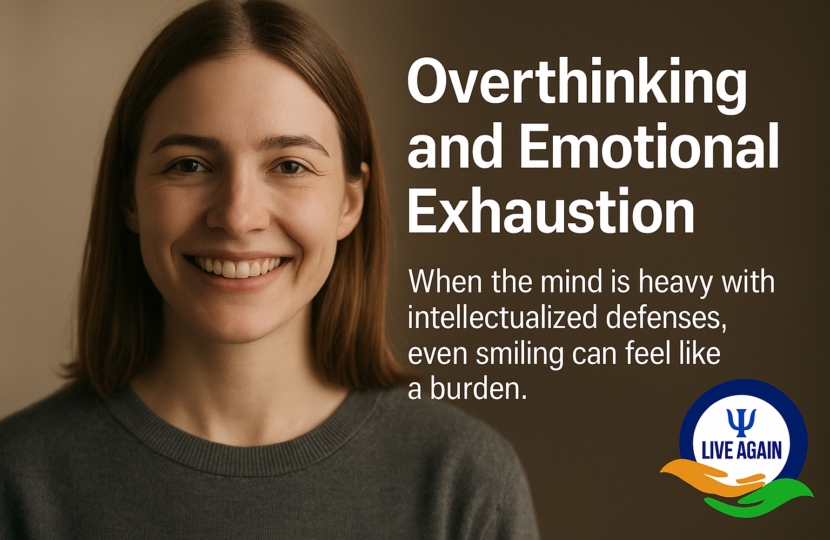
Emotional exhaustion patterns: not all suffering is loud. Some forms of emotional pain arrive quietly – without trauma, without breakdown, without chaos. They don’t come with panic attacks or crying spells. Instead, they come in the form of chronic dissatisfaction, emotional heaviness, overthinking, and a silent voice whispering, “Why does everything feel so hard?”
These subtle forms of pain are often dismissed, even by the person experiencing them. But at Live Again India, we recognize them for what they are – a call for compassionate attention. The presence of emotional exhaustion patterns often reveals deep-rooted, personality-shaped struggles that deserve care, not silence.
What Is Emotional Exhaustion Without Depression?
Emotional exhaustion patterns: Emotional exhaustion is not always clinical depression. Many individuals – especially in mid to late adulthood – report symptoms such as:
- Loss of interest in joyful activities
- Persistent guilt or a sense of personal failure
- Overthinking and indecisiveness
- Difficulty initiating action despite knowing what’s needed
- Tension in relationships that feel emotionally draining
These signs are often misunderstood. They may not meet the diagnostic criteria for major depressive disorder, but yet the individual suffers greatly. Often, this quiet exhaustion arises from personality patterns that have been unconsciously repeated over decades – perfectionism, emotional withdrawal, self-criticism, and over-control.
As cited by the American Psychiatric Association (APA), these personality traits, when rigid or extreme, can impair well-being even in the absence of overt mental illness. According to The American Academy of Pediatrics (AAP), long-term emotional dysregulation often begins early, and without awareness or support, carries into adulthood, shaping lifelong coping mechanisms.
The Overthinking Loop: When Thinking Becomes Protection
One of the clearest signs of emotional exhaustion rooted in personality traits is intellectualization – the habit of processing everything cognitively to avoid emotional exposure.
People caught in this loop often say things like:
“I’ve thought about this a thousand times.”
“I know I’m overreacting, but I can’t stop.”
“I’ll decide tomorrow.” (every day)
This is not avoidance in the casual sense. It is a sophisticated protection mechanism. The mind, fearing emotional pain or vulnerability, keeps the person in a loop of thought without action. Over time, this leads to a breakdown in spontaneity, confidence, and emotional intimacy. The NHS recognizes this pattern as a contributor to emotional fatigue and stress buildup.
Neurologically, chronic overthinking activates the prefrontal cortex but leaves emotional centers (like the amygdala and limbic system) under-processed. This disconnection has been described in studies by Dr. Richard Davidson as a barrier to emotional resilience and regulation.
The Therapy Perspective: From Hesitation to Awakening
Emotional exhaustion patterns: People experiencing emotional exhaustion often show signs of quiet awareness. They know something needs to shift. They say:
- “I want to feel again.”
- “I’m not happy, but I don’t know why.”
- “I can’t seem to change anything, even when I try.”
These clients are not resistant. They are often in the Contemplation–Preparation Stage of motivation, according to RCI, which describe a phase where the individual recognizes the need for change but hasn’t yet built the emotional energy to act.
The purpose of therapy at this stage is to:
- Build emotional insight
- Gently challenge habitual defenses (such as perfectionism or guilt loops)
- Guide the client toward authentic self-acceptance
- Realign their internal narrative and role expectations
This phase of therapy is not fast. But it is foundational.
In neuroscience, this shift is tied to increased activity in the anterior cingulate cortex — the brain’s conflict resolution and emotional integration center. As awareness grows, emotional clarity becomes neurologically supported.
A Reflection for Readers: The Pause That Heals
If you find yourself constantly exhausted, overthinking everything, or unable to make simple decisions — pause. Not to stop your life, but to understand it.
Ask yourself:
- “Am I trying to feel safe by staying still?”
- “Do I forgive myself for not being perfect?”
- “Have I given myself permission to change slowly?”
These are not self-help slogans. They are doorways to self-truth. Your exhaustion may be a message, not a malfunction. Practices like journaling, body scans, and mindful breathwork — as recommended by The Greater Good Science Center at UC Berkeley — help reconnect the emotional and cognitive layers of the self.
How Therapists Can Help You
Therapists are not here to fix you. They are here to help you listen to the parts of you that have been silenced. With training, insight, and presence, a good therapist can help you uncover the patterns behind your emotional heaviness — and gently walk with you toward awareness, acceptance, and autonomy.
At Live Again India, we tailor therapy to match your personality, pace, and stage of change — so that healing becomes not just possible, but sustainable.
Welcome to Live Again
At Live Again India, we support people who may look “fine” on the outside but feel disconnected within. We believe that even subtle emotional exhaustion deserves care, structure, and safe exploration.
You are not alone in this.
We are here — to listen, to reflect, and to guide you back to yourself.