Digital Dopamine Screen Zombies: It’s a striking term, but one that increasingly reflects a widespread modern condition. In today’s hyper-connected world, our attention is constantly pulled by glowing screens, endless notifications, and the relentless hum of digital noise. This constant stimulation, driven by sophisticated algorithms and our brain’s own reward chemistry, is subtly reshaping how we think, feel, and interact with the world around us. This article explores how our ancient dopamine system has been hijacked by modern technology, turning many into what feels like a new kind of being-the “digital zombie”– and, more importantly, how we can awaken and reclaim our attention and lives.
We live in the most connected age in history – yet millions feel more numb, restless, and scattered than ever before. Behind the glow of our screens, something is quietly dying: our presence. Our ability to choose attention. Our inner silence. The term “Digital Dopamine Screen Zombies” may sound dramatic – but it might be the most accurate diagnosis of our time.
Digital Dopamine Screen Zombies: Humanity’s Fall into the Attention Abyss
From Fire to Fiber: The Human Timeline
The Earth formed approximately 4.5 billion years ago, a molten sphere that cooled into the cradle of life. Over billions of years, cells evolved, crawled, swam, climbed, and stood upright. Around 2 million years ago, early hominids crafted tools with purpose. Then came the great leap – around 70,000 years ago -when Homo sapiens gained symbolic thought. This was the ignition of human culture.
We gathered around firelight, told stories that shaped memory, built tribes bound by myth, and rose into civilizations. Each era – stone, bronze, iron, digital – marked not just a change in tools but a shift in how we used attention. From ancient cave paintings to TikTok clips, the arc of evolution has always been guided by one question: what are we focusing on?
From hieroglyphics to the printing press to the smartphone, human evolution is a story of communication. But communication requires attention – and attention, it turns out, is governed by dopamine. Smithsonian Human Origins
The Dopamine Molecule: Evolution’s Reward Code
Dopamine is not just a molecule. It’s the whisper of curiosity, the surge of motivation, the inner music that plays when we move toward something meaningful. It has been our compass for survival – rewarding us for finding food, forming bonds, exploring new paths, and learning from our environment.
In its natural rhythm, dopamine is life’s gentle conductor – guiding us toward meaning, movement, and joy. But in today’s hyperconnected world, that rhythm has been rewired. Instead of flowing like a melody, it now stutters in response to artificial cues – likes, alerts, scrolls. What was once sacred and slow has become shallow and overstimulated. Our inner compass, designed for nature and nuance, is now trapped in loops of noise and novelty.
Every like, every swipe, every ping is designed to hijack this ancient reward system. What was once sacred – our attention, our inner drive – has become commodified. Screens pulse with stimuli our brains were never wired to process at such intensity or frequency.
As Dr. Anna Lembke, author of Dopamine Nation, warns, “We have transformed from seekers into addicts, trapped in loops we don’t even notice.”
We are overfed with rewards and undernourished in presence. APA on Digital Dopamine
Welcome to the Attention Economy: Digital Dopamine Screen Zombies
Attention is no longer just a resource – it’s the most aggressively mined currency on Earth. In boardrooms across Silicon Valley, neuroscientists and behavioral economists collaborate not to heal, but to hook. Every vibration, every notification, every “you might like this” is engineered to hijack your mind. The design isn’t accidental – it’s weaponized.
Endless feeds aren’t free – they come at the cost of your consciousness. Auto-play is not a convenience; it’s a trapdoor into mindless inertia, a loop carefully tuned to override your will. Algorithmic recommendations don’t understand you – they’re designed to bend you. These aren’t just features; they are tools of psychological warfare, crafted to pierce the shield of awareness and rewrite your attention patterns.
This is not an accident. It is architecture – neural, behavioral, and intentional. With every scroll, your focus is splintered. Your curiosity, once organic, is rerouted. The gaze that once searched the world now flickers on glowing rectangles. And slowly, you forget what it felt like to look up, to feel boredom, to choose your next thought instead of being fed one.
Each moment you scroll is a transaction: your time, energy, and presence are traded for ad revenue. You don’t pay with money. You pay with your mind.
This economy thrives on your distraction. What you watch, skip, or click is recorded. Your nervous system is studied. You are not the customer. You are the product. NHS on screen addiction
Generation Screen: Childhood, Teens, and the Lost Minds
Children today are growing up in digital ecosystems that rarely allow for stillness or authentic connection. They spend more hours staring into screens than looking into faces, more time swiping than wandering outdoors. This hyper-digital exposure disrupts the development of empathy, attention span, and emotional regulation. Teenagers now report skyrocketing levels of anxiety, panic, irritability, and depressive states – paired with falling self-esteem and a constant sense of being ‘behind.’
Sleep patterns are broken. Meals are eaten with one hand while the other scrolls. Nature feels distant, eye contact uncomfortable, and real-life presence overwhelming. Social comparison fuels insecurity. Cyberbullying replaces conflict resolution. And emotional numbness becomes a survival strategy in the overstimulated, overfiltered world they inhabit.
The American Academy of Pediatrics notes: “Excessive media use is associated with obesity, poor sleep, school problems, aggression, and other behavior issues.” AAP: Digital Media and Young Minds
Becoming Digital Dopamine Screen Zombies
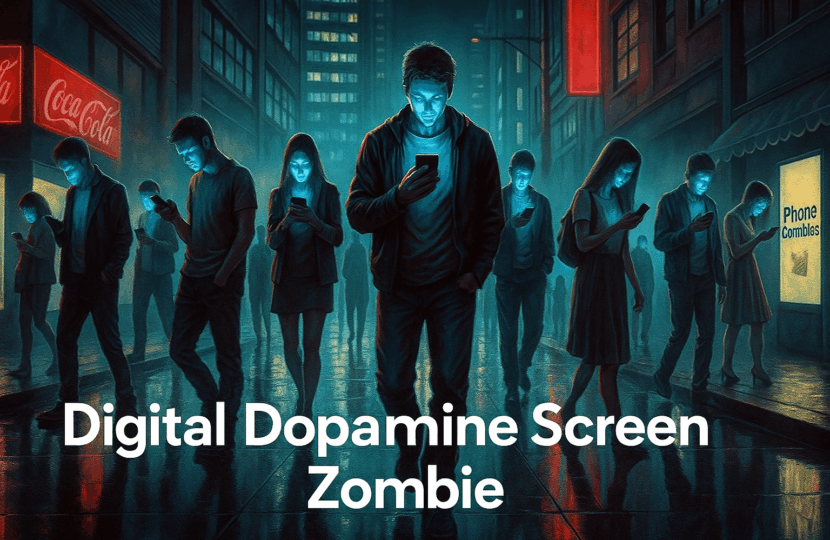
Our bodies are alive, but something essential has gone missing. The eyes – once vibrant, curious, alert – are now glassy, unfocused, lit by the glow of digital fog. The mind floats elsewhere: inside a curated reel, a looping notification, a world made of pixels and dopamine. This is the zombie state – not dead, not dreaming, just disconnected. Our breath continues, but awareness does not. We exist, but we no longer arrive.
We wake, we reach for the screen. We check, scroll, click, swipe, compare. We get numb, and then repeat. This is not human thriving – this is neural collapse. Mirror neurons mimic influencers. We act out what we absorb. We become caricatures of real selves. Slowly, presence vanishes.
The Collapse of Inner Silence
Once, silence was sacred. It wasn’t something to avoid – it was something we returned to. We gazed at stars without needing to capture them. We listened to rain without skipping it. We watched our thoughts pass like clouds. In silence, imagination was born, daydreams wandered, creativity sparked.
Today, that silence is exiled. Every pause is filled. Every still moment is interrupted. We reach for our phones not out of need, but out of an inability to just be. The modern mind finds boredom intolerable, because boredom invites truth.
Digital noise now replaces inner stillness. It overwhelms the quiet space where emotions once breathed and where insights once landed. The mind becomes crowded. Feelings blur. Attention shatters.
We forget how to wait. We forget how to sit. We forget how to listen – truly listen – to ourselves, to others, to life itself. The result is not just stress or distraction, but the erosion of presence.
Without silence, emotional regulation collapses. Without silence, imagination dies. Without silence, we lose access to the most human parts of ourselves. Neuroscience on Digital Overload
Is It Too Late? Waking Up from the Zombie Mode
No. But awakening requires withdrawal. It requires discomfort, friction, patience. Like any addiction, healing the digital dopamine system takes time. Start with one hour screen-free. Feel the panic, the craving. Breathe through it. Begin digital fasting. Practice attention training. Journal. Move your body. Sit in silence. Feel again.
Presence is painful at first. But it becomes beautiful.
How Therapists Can Help You
Therapists can help you identify patterns of screen dependency, regulate your dopamine pathways, rebuild real-life focus, and rediscover emotional aliveness. Therapy supports re-training the nervous system from zombie-mode into presence, purpose, and peace.
Welcome to Live Again
Welcome to Live Again. Live Again India Mental Wellness is here to support your recovery from screen-induced disconnection. You are not alone. Let’s reclaim your inner stillness and joy-together.
At Live Again, we believe your attention is sacred – and your life deserves presence, not programming.
If you are experiencing any mental health issue, or know someone, who is suffering. Seek Professional Help and talk to your mental health expert. Your mental health care is our priority. Your life is precious; take care of yourself and family. You are not alone. We are standing by you. Life is beautiful. Live it fully. Say yes to life. Welcome to life.