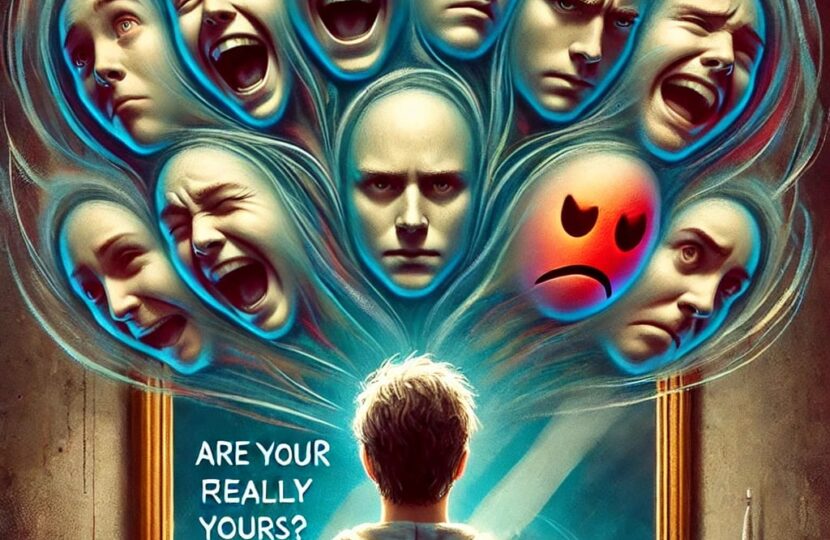
Have you ever walked into a room, felt tense within seconds – and later realized nothing “bad” actually happened to you? That invisible transfer is called emotional contagion, a natural human process where we “catch” the moods of people around us. Today, there’s a new amplifier: constant notifications and online feeds. Together, borrowed emotions mental health becomes a hidden load – anxious, heavy, and exhausting – without you noticing until sleep, focus, and relationships suffer. See the American Psychological Association (APA) overview for a simple, clinical description: apa.org.
Borrowed Emotions Mental Health: why you carry feelings that aren’t yours and how the digital cage amplifies them?
Borrowed Emotions Mental Health: what “borrowing” really means
We are wired to mirror others. Without thinking, our face, voice, and even heart rate can echo the person next to us; it’s a social glue that helps us belong. The psychology term is emotional contagion – the “spread” of feelings from one person to many. This can be positive (calm spreads calm) or negative (stress spreads stress), and it happens offline and online alike. my.clevelandclinic.org.
Emotional contagion in simple words
Emotional contagion means we unconsciously “copy” the emotions of people around us, often through tiny signals: facial expression, tone, posture, or even text and emojis online. This is why a single anxious colleague can set the whole team on edge, or why a hopeful coach can lift an entire group. NHS symptom guides help you notice and name feelings: nhs.uk.
Borrowed Emotions Mental Health: the digital cage of notifications
Phones ping. Apps vibrate. The brain expects a “reward” each time – likes, messages, breaking news – and the variability of these rewards drives compulsion. This variable reward pattern (sometimes you get something exciting, often you don’t) hooks attention and nudges us to check again and again. That loop intensifies anxiety and can keep you in streams where other people’s fear or anger “bleeds” into you. For balanced digital well‑being guidance, see APA’s resources on technology and mental health: apa.org.
Why alerts feel irresistible
Even silent or missed notifications tug your mind, lowering self‑control and pulling attention off the task at hand. The brain begins to expect a reward, so you keep checking even when nothing new has arrived. This constant “micro‑pull” tires the system, creating mental fog and choppy focus. In that tired state, it becomes harder to separate what you truly feel from what others are feeling online. The result is a faster spread of borrowed emotions and more anxiety, even without a clear personal trigger.
Borrowed Emotions Mental Health: when timelines transfer moods
Online spaces transmit emotions quickly. In support communities, sharing pain can help; yet prolonged exposure to intense negative affect can also deepen one’s own symptoms if there’s no balance or boundary. This is the borrowed emotions trap: we come to “carry” moods from feeds, group chats, and comment loops that were never ours to begin with.
Unspoken emotions travel fast
Emotions can spread in families and groups like a ripple in water, so one person’s stress or low mood often affects everyone nearby. When we are not aware, we may “borrow” these feelings and assume they are our own. This can change how we think, speak, and act, even if nothing happened directly to us. Learning to pause and ask, “Is this mine or carried from someone else?” helps you respond with clarity. For simple guidance on stress, mood, and next steps, see the NHS: nhs.uk/mental-health.
Signs you may be carrying what isn’t yours
- Your mood shifts sharply after time on social media or messaging apps.
- You feel tense after a meeting or call, but can’t name a personal trigger.
- You replay someone else’s issue in your head long after the conversation.
- Sleep is lighter, attention is scattered, and small triggers feel bigger.
- You find yourself scrolling for relief but feel worse afterward.
These are common and human; the solution begins with awareness, not blame.
The brain, dopamine, and the “check again” loop
Dopamine doesn’t equal “pleasure only”—it marks salience and “go see” motivation. Notifications create a craving to resolve uncertainty (“Who texted? What did I miss?”). That craving is stronger when rewards are unpredictable. Over time, this loop can elevate stress and reduce the space you need to notice: “Is this emotion mine or borrowed?” For family‑friendly digital guidance, see the American Academy of Pediatrics (AAP) Family Media Plan: aap.org
Practical family guidance on screens
There’s no single “magic number” for screen time that suits everyone. Instead, pediatric guidance encourages family plans: co‑created rules about when, where, and how devices are used (meals, bedtime, homework), emphasizing quality, context, and balance. See AAP and NHS overviews: aap.org, nhs.uk.
Borrowed Emotions Mental Health: everyday situations (quick snapshots)
- The group chat spiral: One person’s panic spreads; an entire chat becomes restless. You feel wired -though your day was fine.
- News doom‑scroll: Late‑night scrolling raises your heart rate; sleep fragments.
- Work contagion: A teammate’s irritability sets a tense tone; you carry the residue home.
- Family loop: A loved one’s sadness silently shapes everyone’s evening mood.
This is a simple, science‑backed reminder: our brains naturally mirror others, so borrowed feelings are normal. With awareness, you can pause and ask, “Is this mine or carried from someone else?” Small, steady habits – screen boundaries, breath resets, and better sleep – gradually reduce overload. If feelings stay heavy, reach out for guided support at www.liveagainindia.com; you are not alone.
Borrowed Emotions Mental Health: How it affects mental health
1) Sleep & body rhythm
- Borrowed stress keeps your brain on “alert” even at night.
- Sleep becomes shallow, with more waking and vivid dreams.
- You wake tired, head heavy, and the body may feel stiff or achy.
- Next day, patience is low and cravings for screens or sugar rise.
2) Anxiety & panic sensitivity
- Others’ fear and constant alerts raise your base anxiety.
- Small triggers feel big; heart rate jumps quickly.
- Breath shortens and chest tightness may appear without a clear cause.
- Worry loops replay in your head long after the trigger ends.
3) Mood & motivation
- Absorbed sadness flattens mood and drains energy.
- Joy feels distant; activities you loved seem dull.
- Motivation drops; tasks get delayed or avoided.
- If this continues, it can resemble mild depression.
4) Focus & decisions
- Notifications cut attention into tiny pieces.
- Borrowed emotions fog thinking and slow memory recall.
- Choices become quick and less balanced under pressure.
- Errors increase, and work takes longer than it should.
5) Relationships & conflict
- You carry others’ moods into home or work without noticing.
- Misreading tone, you react fast and the issue escalates.
- Arguments start from emotion, not facts or intent.
- Empathy turns to exhaustion – what we call “empathy fatigue.”
Borrowed Emotions Mental Health: digital detox that real life can keep
Micro‑detox works better than “all‑or‑nothing”:
- Notifications: Off for non‑essentials; batch‑check messages three times daily.
- Tech‑free anchors: Meals, first/last 30 minutes of the day, and one hobby hour.
- Night hygiene: Phone out of the bedroom; protect 7–8 hours of sleep.
- “One screen at a time” rule: No second‑screen during work or rest.
Helpful resources: AAP Family Media Plan at aap.org and APA tech resources at apa.org.
Borrowed Emotions Mental Health: quick self‑check (2 minutes)
A. Before opening a feed:
• What do I want from the next 10 minutes (learn, connect, rest)?
• How will I know to stop (timer, 10 posts, one conversation)?
B. After closing a feed:
• What feeling do I have now (lighter/same/heavier)?
• If heavier, is it mine or borrowed from what I just saw?
If you often feel heavier after scrolling, it means you may be absorbing other people’s moods. Start by curating sources—mute accounts that trigger anxiety and follow calmer, factual ones. Limit your exposure windows (batch‑check in the day, avoid late‑night feeds) so your mind gets recovery time. Protect sleep by keeping devices out of the bedroom and stopping screens at least 60 minutes before bed.
When to seek professional help
Consider reaching out when:
- Sleep is persistently poor; you wake unrefreshed.
- You feel emotionally flooded most days.
- Relationships or work are repeatedly strained.
- You can’t tell what you really feel, beyond others’ moods.
How therapists can help you
A therapist helps you separate your core feelings from borrowed ones, and design a screen plan that protects sleep and focus. You learn simple nervous‑system resets that make empathy safer. Together, you build boundaries that keep relationships warm, not overwhelming.
Care is collaborative—pace, tools, and goals are shaped with you.
Welcome to Live Again India “you are not alone”
Welcome to Live Again India Mental Wellness—where compassionate, evidence‑informed care meets real‑life challenges. If borrowed emotions mental health feels heavy, you don’t have to carry it alone.
We offer structured assessment, therapy, and family support – online and at our clinic in Hauz Khas, New Delhi.
For awareness, appointments, and treatment support, visit www.liveagainindia.com – we are with you.
🏳🌈 Welcome to Live Again. Live Again India Mental Wellness is supporting you – you are not alone.
If you are experiencing any mental health issue, or know someone, who is suffering. Seek Professional Help and talk to your mental health expert. Your mental health care is our priority. Your life is precious; take care of yourself and family. You are not alone. We are standing by you. Life is beautiful. Live it fully. Say yes to life. Welcome to life.