

Overthinking at Night Insomnia
At night, the mind doesn’t “go crazy”—it tries to protect you by chasing certainty.
However, when the nervous system stays activated, thoughts speed up and sleep turns into a test.
Therefore, the goal isn’t to solve life at 2 AM; it’s to lower arousal and retrain the bed as a safety cue.
With small, consistent steps, the brain relearns quiet—and sleep returns more naturally.
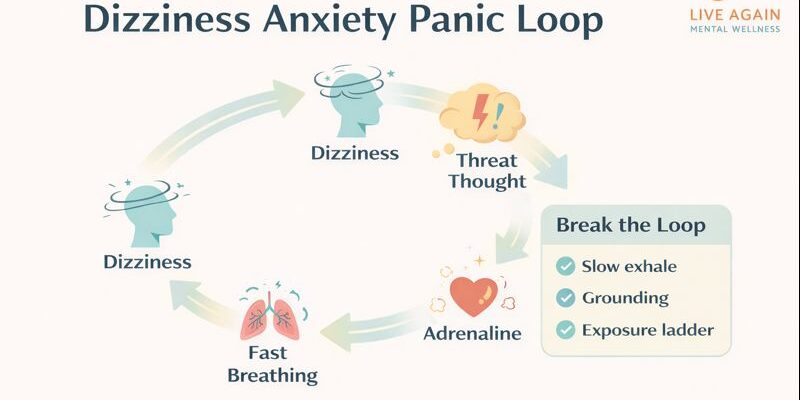
Dizziness Anxiety Panic Loop
Dizziness can feel like a medical emergency, but for many people it becomes an anxiety–panic feedback loop driven by fear and adrenaline.
A sudden body sensation triggers a threat interpretation, which spikes arousal, tightens breathing, and amplifies light-headedness.
The goal is not to “fight” dizziness, but to retrain safety through slow exhale, grounding, and graded exposure to avoided situations.
With consistent CBT-style practice, the brain learns: “This sensation is uncomfortable, not dangerous”—and the loop weakens.
L@A